


Force-transmitting flange joint
DN300-DN1800
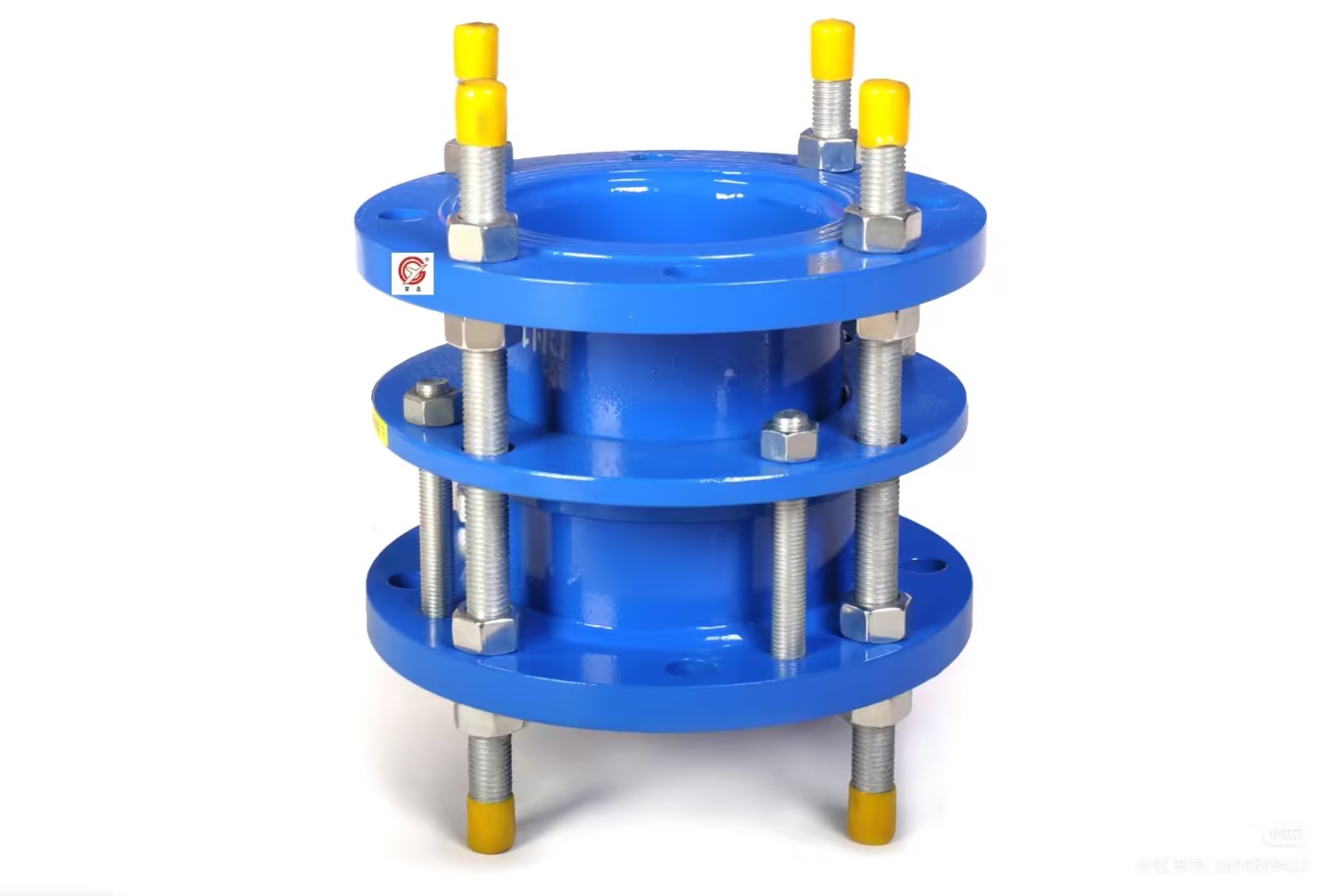
Force-transmitting flange joint is a special flange assembly matched with pipe expansion joints. It evenly transfers axial thrust, bending moment and shear load of pipelines, preventing flexible components such as bellows from bearing excessive pipeline stress alone.
Consisting of paired flanges, high-strength bolts, gaskets and force-transfer rings, this joint balances thermal expansion stress, restricts pipeline displacement and shares loads of pipe supports. Manufactured in carbon steel or stainless steel complying with ASME and DIN EN standards, it is widely applied in heating, chemical, oil & gas and water supply piping systems.
Consisting of paired flanges, high-strength bolts, gaskets and force-transfer rings, this joint balances thermal expansion stress, restricts pipeline displacement and shares loads of pipe supports. Manufactured in carbon steel or stainless steel complying with ASME and DIN EN standards, it is widely applied in heating, chemical, oil & gas and water supply piping systems.
Delivery
EXW
minimum order
1 piece
Supply Ability
100piece / Week
Country of Origin
CHINA
Stock Time
14Day
Quantity:
US $100.00 - US $2000.00 / piece
A force-transmitting flange joint is a specialized structural piping connector designed for stress balance and load transfer in industrial pipeline systems. Different from ordinary standard flange joints that only undertake sealing and connecting functions, this reinforced flange assembly is engineered to bear and redistribute pipeline pressure thrust, axial tension, bending moment and shear force. It is widely matched with pipe expansion joints, bellows compensators, pumps and valve equipment to solve the problem of local stress concentration in flexible pipeline sections.
1. Basic Structural Composition
The complete force-transmitting flange joint assembly consists of multiple precision-matched components to realize dual functions of sealing and force transmission. The core parts include paired integral or loose flanges, high-strength alloy fastening bolts and nuts, elastic sealing gaskets, force-transfer rings and limit sleeves. All load-bearing components are generally made of carbon steel or stainless steel with high tensile strength, fully compliant with ASME B16.5, DIN EN and GB industrial piping standards. The structural cooperation between internal sleeves and flanges ensures synchronous force bearing of the whole joint, avoiding independent stress on single local parts.
2. Working Principle
During pipeline operation, internal medium pressure will generate continuous axial blind thrust on pipe sections and flexible compensators. Ordinary expansion joints lack rigid force-bearing structures and are prone to deformation, damage or even fracture under long-term thrust load. The force-transmitting flange joint forms an integral rigid force-bearing system through pre-tightened high-strength bolts. It transfers the original concentrated thrust on the bellows or pipeline end evenly to the entire pipe network and fixed support structure. Meanwhile, the joint maintains reliable compression on the sealing gasket, eliminating leakage risks while controlling excessive axial and radial displacement of the pipeline. It can also offset installation errors and micro displacement caused by foundation settlement.
3. Core Technical Features & Advantages
First, it achieves effective stress protection. It isolates flexible components from rigid pipeline stress, greatly extending the service life of bellows, rubber expansion joints and other vulnerable parts, and protecting precision equipment such as pumps and valves from thrust impact. Second, it realizes uniform load distribution. The overall force-transmitting structure disperses local concentrated load to the pipeline support and fixing system, reducing the failure rate of pipeline brackets and hanger components. Third, it integrates multiple performance advantages including reliable sealing, dimensional adjustability and convenient installation and maintenance. The adjustable compression structure of the gasket can adapt to different medium pressure levels, and the modular assembly greatly improves the efficiency of on-site installation and later overhaul. Fourth, it has strong environmental adaptability, stably working under high temperature, high pressure and conventional corrosive medium conditions with stable structural strength and sealing performance.
4. Main Classification
According to structural forms and functional differences, force-transmitting flange joints are mainly divided into single-flange force-transmitting type and double-flange force-transmitting type. The single-flange type features a compact structure, mainly used for loose connection and force transmission matching of pumps, valves and short pipe sections, which can balance pressure thrust but has limited displacement compensation capacity. The double-flange type is a full-range force-transmitting structure with synchronous force bearing on both sides, which can not only transfer full pipeline load but also compensate thermal expansion and contraction displacement and installation deviation of the pipeline, suitable for long-distance and high-load industrial pipe networks.
5. Application Scenarios
This type of joint is standard supporting equipment for medium and high-pressure industrial piping systems. It is extensively applied in thermal heating pipelines, petrochemical fluid transmission pipelines, oil and gas gathering and transportation pipelines, municipal water supply and drainage pipe networks, as well as power plant and pharmaceutical industrial piping systems. It is especially suitable for pipeline sections equipped with expansion joints, where stress balance and displacement control are required, effectively ensuring the overall structural stability and long-term safe operation of the pipe network system.
Recommend Products
