


DN500 Universal Flange Connection Stainless Steel Metal Bellows Expansion Joint Compensator
Key Design Features
Universal Movement Capability: The core advantage of this design is its ability to absorb large lateral deflections that a standard axial joint cannot handle. By utilizing two bellows or a specialized lateral structure, the compensator accommodates compound movements, reducing stress on anchors and connected equipment. For installations where pressure thrust must be restrained, tie rods (limit rods) are typically supplied to transfer the reaction force to the pipe anchors, preventing the bellows from over-extending.
Stainless Steel Bellows Construction: The flexible element is fabricated from high-grade stainless steel (commonly AISI 304, 316L, or 321) to resist corrosion, high temperatures, and fatigue. The multi-ply bellows design, where applicable, enhances pressure resistance and cycle life. For DN500 specifically, the bellows are precision-formed to ensure uniform convolution geometry and predictable spring rates.
Flange Connection: The unit features welded or rotatable flanges at both ends. Standard drilling is available to match common international standards including EN 1092, ANSI/ASME B16.5, and JIS, ensuring compatibility with diverse global piping systems. The flanges are typically carbon steel with anti-corrosion coating or stainless steel to match the bellows material.
Technical Specifications (Typical for DN500)
The nominal diameter is DN500 (approximately 20 inches). The bellows are typically made from AISI 304, 316L, or 321 stainless steel, while the flanges are available in carbon steel (such as St37.2) with anti-corrosion coating or in stainless steel to match the bellows. Flange drilling can be supplied to EN 1092-1, ANSI B16.5, JIS, or custom requirements. Standard pressure ratings include PN10, PN16, and Class 150, with higher ratings available on request. The operating temperature range is generally from -20°C to 450°C, depending on the material grade selected. The unit provides universal movement capability covering axial, lateral, and angular displacement. Common accessories include tie rods, internal guide sleeves, and limit rods.
Applications
This DN500 universal compensator is engineered for robust service in district heating and cooling networks, where it absorbs thermal expansion in large transmission mains. In industrial plant piping, it connects pumps, turbines, and compressors where vibration isolation and misalignment compensation are critical. Chemical and petrochemical facilities use it for handling corrosive media when constructed with 316L or higher-grade stainless steel. Steam and exhaust systems rely on it to manage high-temperature movements in boiler and flue gas lines. Water and wastewater treatment plants employ it to provide flexible connections in large header manifolds.
Installation and Selection Notes
Proper anchoring is essential for universal unrestrained expansion joints. Because this type does not inherently restrain pressure thrust (unless specified with tie rods), the piping system must be equipped with adequate main anchors and pipe guides to prevent the bellows from being over-stretched or compressed by internal pressure forces. During installation, the expansion joint should not be used to pull misaligned pipe ends together; pre-compression or pre-stretching, if required by the design, must be performed according to the manufacturer's instructions. The internal sleeve (if supplied) must be oriented in the direction of flow to prevent turbulence and erosion.
Note: For a specific project, always request the manufacturer's detailed data sheet for the exact DN500 model, as movement capacities (axial and lateral in millimeters), spring rates, and effective areas vary by design and pressure rating.
 Universal Lateral Metal Bellows Compensator Suited for High-Pressure High-Flow Conditions
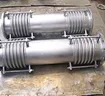 Customable Universal Flanged Metal Bellows Expansion Joint Compensator
 DN250 Universal Welding Stainless Steel Metal Bellows Expansion Joint Compensator
 Free Double Metal Bellows Expansion Joint, Stainless Steel Corrugated Compensator for Pipeline Thermal Movement