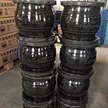
EPDM/NBR/Hypalon Single Sphere Rubber Ball
DN25-DN2000.
The Single Sphere Rubber Expansion Joint is a flexible pipe connector designed to absorb vibration, noise, thermal movement, and misalignment in piping systems. It features a single spherical rubber body reinforced with high-strength synthetic fabric and metal wire, ensuring excellent flexibility and pressure resistance. The joint is available in three premium rubber materials — EPDM, NBR, and Hypalon — each suited to different media and environmental conditions.
Delivery
FOB
minimum order
10 pieces
Supply Ability
100pieces / Month
Country of Origin
China
Stock Time
20-30Day
Quantity:
US $1.00 - US $100.00 / pieces
Material Options and Characteristics
EPDM (Ethylene Propylene Diene Monomer)
EPDM offers outstanding resistance to weathering, ozone, aging, and UV radiation. It performs exceptionally well in hot water, steam, and outdoor applications. It is compatible with water, seawater, mild acids, alkalis, and polar fluids. Temperature range: -40°C to +120°C (up to 150°C for short periods). EPDM is the ideal choice for HVAC systems, cooling water lines, and potable water applications.
EPDM offers outstanding resistance to weathering, ozone, aging, and UV radiation. It performs exceptionally well in hot water, steam, and outdoor applications. It is compatible with water, seawater, mild acids, alkalis, and polar fluids. Temperature range: -40°C to +120°C (up to 150°C for short periods). EPDM is the ideal choice for HVAC systems, cooling water lines, and potable water applications.
NBR (Nitrile Butadiene Rubber)
NBR provides excellent resistance to oils, fuels, greases, and hydraulic fluids. It is widely used in petroleum-based media and applications where oil resistance is critical. Temperature range: -30°C to +100°C. NBR is not recommended for exposure to strong acids, ketones, or ozone. Typical applications include oil pipelines, fuel systems, and lubricant transfer lines.
NBR provides excellent resistance to oils, fuels, greases, and hydraulic fluids. It is widely used in petroleum-based media and applications where oil resistance is critical. Temperature range: -30°C to +100°C. NBR is not recommended for exposure to strong acids, ketones, or ozone. Typical applications include oil pipelines, fuel systems, and lubricant transfer lines.
Hypalon (Chlorosulfonated Polyethylene)
Hypalon delivers superior resistance to ozone, weathering, oxidation, and a wide range of chemicals, including acids, alkalis, and hypochlorite solutions. It also offers good flame retardancy. Temperature range: -20°C to +120°C. Hypalon is commonly used in chemical processing, water treatment, and outdoor installations where extreme weather and chemical exposure are concerns.
Hypalon delivers superior resistance to ozone, weathering, oxidation, and a wide range of chemicals, including acids, alkalis, and hypochlorite solutions. It also offers good flame retardancy. Temperature range: -20°C to +120°C. Hypalon is commonly used in chemical processing, water treatment, and outdoor installations where extreme weather and chemical exposure are concerns.
Construction
The single sphere body is constructed from multiple layers of rubber compound with embedded fabric reinforcement and steel wire rings. The flanges are typically made of carbon steel, stainless steel, or ductile iron, drilled to standard ANSI, DIN, JIS, or BS specifications. The joint may be supplied with or without control rods, depending on the application requirements.
The single sphere body is constructed from multiple layers of rubber compound with embedded fabric reinforcement and steel wire rings. The flanges are typically made of carbon steel, stainless steel, or ductile iron, drilled to standard ANSI, DIN, JIS, or BS specifications. The joint may be supplied with or without control rods, depending on the application requirements.
Key Features
Single sphere design for maximum flexibility and movement absorption
High tensile strength and tear resistance
Excellent vibration and noise damping
Resistant to abrasion, aging, and various chemicals
Available in a wide range of sizes from DN25 to DN1200
Working pressure: PN10, PN16, PN25 (depending on size and material)
Vacuum resistance: up to 760 mmHg
Applications
Suitable for HVAC systems, water supply and drainage, chemical processing, petrochemical industry, power plants, marine and offshore piping, pulp and paper mills, and wastewater treatment facilities.
Suitable for HVAC systems, water supply and drainage, chemical processing, petrochemical industry, power plants, marine and offshore piping, pulp and paper mills, and wastewater treatment facilities.
Installation Notes
Install the joint in the pipeline with proper alignment. Do not stretch or compress beyond the allowable movement limits. Use control rods when large axial movements are expected. Ensure flanges are clean and bolts are tightened evenly in a diagonal pattern. Avoid contact with sharp objects and protect from direct sunlight if EPDM or NBR is used in outdoor applications.
Install the joint in the pipeline with proper alignment. Do not stretch or compress beyond the allowable movement limits. Use control rods when large axial movements are expected. Ensure flanges are clean and bolts are tightened evenly in a diagonal pattern. Avoid contact with sharp objects and protect from direct sunlight if EPDM or NBR is used in outdoor applications.
Quality Assurance
Each unit is hydrostatically tested before shipment. Material certificates and test reports are available upon request. Custom sizes, special flange drilling, and alternative rubber compounds can be provided to meet specific project requirements.
Each unit is hydrostatically tested before shipment. Material certificates and test reports are available upon request. Custom sizes, special flange drilling, and alternative rubber compounds can be provided to meet specific project requirements.