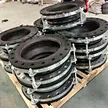
Full Face Flanged EPDM/NBR/HYPALON Rubber Expansion Joint Connector
DN400 16''-DN2000 80''
The Full Face Flanged Rubber Expansion Joint Connector is a high-performance flexible piping component designed to absorb vibration, noise, thermal expansion, and misalignment in pipeline systems. Manufactured with a full-face flange design, this expansion joint ensures a uniform sealing surface that matches the entire flange face of the mating pipe, providing superior sealing integrity and reducing the risk of leakage. It is available in three premium elastomer materials: EPDM, NBR, and HYPALON, each offering distinct advantages for different media and operating conditions.
Delivery
FOB
minimum order
1 piece
Supply Ability
100piece / Month
Country of Origin
China
Stock Time
30Day
Quantity:
US $200.00 - US $10000.00 / piece
Design and Construction
The connector consists of a molded rubber body reinforced with high-strength synthetic fabric or steel wire carcass, depending on the application requirements. The full-face flanged ends are integrally molded with the rubber body, eliminating the need for separate gaskets and ensuring a seamless, leak-proof connection. The flange dimensions conform to international standards such as ANSI, DIN, JIS, and BS, allowing easy installation between standard pipe flanges. The rubber body is engineered with multiple convolutions to provide excellent flexibility in axial, lateral, and angular movements while maintaining structural integrity under pressure.
Material Options and Characteristics
EPDM (Ethylene Propylene Diene Monomer): EPDM offers outstanding resistance to weathering, ozone, aging, and UV radiation. It performs exceptionally well with hot and cold water, steam (low pressure), and various chemical solutions. EPDM is ideal for outdoor installations, HVAC systems, and potable water applications. Its temperature range typically spans from -40°C to 120°C, with short-term peaks up to 150°C.
NBR (Nitrile Butadiene Rubber): NBR is renowned for its excellent resistance to oils, fuels, greases, and hydraulic fluids. It is the preferred choice for petroleum-based media and applications involving hydrocarbon derivatives. NBR also provides good resistance to water and moderate chemical exposure. Its operating temperature range is generally from -30°C to 100°C, with intermittent service up to 120°C.
HYPALON (Chlorosulfonated Polyethylene): HYPALON combines excellent resistance to ozone, weathering, and a wide range of chemicals, including acids, bases, and oxidizing agents. It also exhibits good flame resistance and low permeability. HYPALON is particularly suitable for aggressive chemical processing, wastewater treatment, and marine environments. Its temperature range is typically from -20°C to 120°C, with short excursions up to 140°C.
Key Features and Benefits
The full-face flange design provides a larger sealing area, reducing bolt torque requirements and ensuring a tight seal even under uneven flange surfaces. The flexible rubber body effectively isolates vibration and noise from pumps, compressors, and other rotating equipment, extending the life of the piping system. The connector accommodates piping misalignment caused by thermal expansion, settling, or installation tolerances, reducing stress on pipe supports and anchors. The reinforced carcass ensures high burst pressure and vacuum resistance, making the connector suitable for both pressure and suction lines. Installation is straightforward, requiring no special tools, and the connector is maintenance-free under normal operating conditions.
Technical Specifications
Available sizes typically range from DN25 to DN1200 (1 inch to 48 inches), with larger sizes available upon request. Working pressure ratings vary from 10 bar to 25 bar depending on size, material, and reinforcement type. Burst pressure is generally four to five times the working pressure. Vacuum ratings are available for specific configurations. Flange drilling can be customized to meet ANSI 150/300, DIN PN10/16/25, JIS 5K/10K/16K, and BS Table D/E/F standards. The connectors are tested in accordance with ISO 9001 quality management systems and can be supplied with material certificates and pressure test reports.
Applications
These expansion joints are widely used in HVAC systems, water supply and drainage networks, chemical processing plants, oil and gas facilities, power generation stations, marine and offshore engineering, wastewater treatment plants, food and beverage industries, and pharmaceutical manufacturing. They are particularly effective in connecting pumps, chillers, cooling towers, heat exchangers, and other equipment where vibration isolation and flexibility are critical.
Installation Guidelines
Proper installation is essential to maximize performance and service life. The expansion joint should be installed in the neutral position, neither compressed nor extended, unless specific pre-compression or pre-extension is required. Flange bolts should be tightened evenly in a diagonal pattern to the recommended torque. The connector should not be used to support the weight of adjacent piping; independent pipe supports must be provided. Avoid sharp bends or twisting during installation. When used in high-temperature or chemical applications, ensure the selected elastomer is fully compatible with the media and operating conditions.
Quality Assurance
Each expansion joint is manufactured under strict quality control procedures, including raw material inspection, dimensional checks, pressure testing, and final visual examination. The product complies with relevant international standards such as ASTM, ISO, and EN. Custom designs, special materials, and non-standard flange configurations are available to meet specific project requirements.