
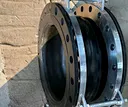

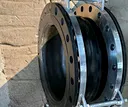
Full Face Flanged Expansion Joint
DN400-DN2000
Full Face Flanged Rubber Expansion Joints are high-performance, custom-engineered flexible connectors designed to absorb pipeline movement, dampen vibration, and compensate for thermal expansion in piping systems. The distinguishing feature of this product is the full face rubber flange, which is integrally molded with the bellow body, creating a continuous, leak-proof sealing surface that conforms to the bolt pattern of the companion pipe flanges. These integral flanges eliminate the need for separate gaskets at installation, providing a self-sealing connection that simplifies assembly and enhances system reliability.
Delivery
FOB
minimum order
1 piece
Supply Ability
10piece / Month
Country of Origin
China
Stock Time
20-25Day
Quantity:
US $100.00 - US $15000.00 / piece
## Key Features and Benefits
The integral full face sealing surface ensures a tight seal against flat-faced or raised-face pipe flanges without requiring additional gaskets, reducing installation time and potential leak points. The self-sealing design eliminates the need for separate gaskets, which simplifies assembly and minimizes maintenance concerns.
The elastomeric body effectively absorbs mechanical vibration and dampens fluid-borne noise in pumping and compressor systems, contributing to quieter and more stable plant operations. The expansion joint accommodates multi-directional movement, including axial extension and compression, lateral deflection, and angular rotation, thereby preventing excessive stress on connected equipment and pipe supports.
Construction incorporates multiple layers of high-strength synthetic cord fabric, such as nylon or polyester, with optional wire reinforcement to provide robust pressure ratings and structural integrity. The product is available in a wide range of elastomers and configurations to suit diverse operating conditions and pipe standards.
## Technical Specifications
The rubber bellows and integral flanges can be manufactured from various elastomers to match media compatibility and temperature requirements. EPDM and high-temperature EPDM grades offer excellent performance for water, sewage, hot water, and outdoor weathering, with temperature capabilities up to 115°C, and special compounds are available for service up to 250°C. Nitrile rubber is suitable for oil, fuel, and hydrocarbon applications. Hypalon provides good resistance to ozone, acids, and weather exposure. Viton is recommended for high-temperature chemical resistance, while chloroprene offers balanced performance for oils, weather, and moderate chemicals. Butyl rubber is ideal for acids, alkalis, and high vacuum applications.
Backing flanges are available in standard carbon steel with shot-blasting and painting, with optional upgrades to hot-dip galvanized carbon steel or various grades of stainless steel and aluminum. Flange drilling complies with international standards including EN, ANSI and ASME Class 125 and 150, AWWA, and JIS, with custom drilling patterns available upon request.
The expansion joints are manufactured in diameter ranges from DN400 to DN 2000, covering sizes from half an inch to over 80 inches. Pressure ratings extend up to 16 barg depending on size and design, and vacuum service capability is supported with the inclusion of internal vacuum rings. Standard temperature ranges span from -20°C to 115°C, with extended options available from -30°C up to 250°C.
Axial and lateral displacement capacities vary by size and arch configuration. Typical single-arch joints provide extension up to 16 to 25 millimeters and compression of 10 to 25 millimeters depending on nominal diameter, while multiple arch designs accommodate greater movements.
## Design and Configuration Options
Unrestrained designs feature a single or multiple arch flexible element with no mechanical restraint. In these configurations, pressure thrust forces must be absorbed by properly designed pipe anchors and guides.
Restrained designs incorporate tie rods with double nuts and spherical washers to limit over-elongation and absorb pressure thrust, allowing lateral and angular movement while protecting piping from thrust forces.
Hinged configurations permit angular movement in one plane only through hinge mechanisms designed to accept full pressure thrust. Gimbal designs allow angular movement in any plane through two pairs of hinges affixed to a floating gimbal ring, effectively restraining pressure thrust while providing universal angular flexibility.
Pressure balanced designs incorporate an additional balancing bellows to neutralize pressure thrust forces, protecting sensitive equipment such as turbines, and are available in both in-line and elbow configurations.
Specialized variants include rectangular designs for low-pressure and vacuum applications in power and industrial sectors, as well as reducing or offset configurations for connecting pipes of different diameters or correcting misalignment.
Available accessories include multiple arch designs for increased movement absorption, internal vacuum rings required for vacuum service applications, PTFE or fluoroplastic linings for maximum chemical resistance and a smooth flow bore, inner sleeves to reduce turbulence and protect against abrasive media, protective covers such as expanded metal, fire-resistant, or UV covers for external protection, and control units with tie rod systems and spherical washers for safe movement management.
## Installation and Maintenance Guidelines
The full face rubber flange is designed for connection to flat-face pipe flanges. If the mating flange has a raised face, the recess must be equalized to avoid damaging the rubber surface. This can be achieved using separate steel plates or by specifying compensation molded directly into the rubber flange.
Bolts must be tightened evenly using the cross-pattern method. Overtightening to the point of metal-to-metal contact between the backing flange and the pipe flange must be avoided. Following initial installation, bolt torque should be rechecked after 24 hours and again after three weeks to accommodate rubber relaxation.
These joints are not intended for bolting directly to another elastomeric-faced component without proper transition flanges. Bolts should be installed from the bellow side where possible, and excessive bolt length must not contact the rubber bellow under pressure.
The integral full face sealing surface ensures a tight seal against flat-faced or raised-face pipe flanges without requiring additional gaskets, reducing installation time and potential leak points. The self-sealing design eliminates the need for separate gaskets, which simplifies assembly and minimizes maintenance concerns.
The elastomeric body effectively absorbs mechanical vibration and dampens fluid-borne noise in pumping and compressor systems, contributing to quieter and more stable plant operations. The expansion joint accommodates multi-directional movement, including axial extension and compression, lateral deflection, and angular rotation, thereby preventing excessive stress on connected equipment and pipe supports.
Construction incorporates multiple layers of high-strength synthetic cord fabric, such as nylon or polyester, with optional wire reinforcement to provide robust pressure ratings and structural integrity. The product is available in a wide range of elastomers and configurations to suit diverse operating conditions and pipe standards.
## Technical Specifications
The rubber bellows and integral flanges can be manufactured from various elastomers to match media compatibility and temperature requirements. EPDM and high-temperature EPDM grades offer excellent performance for water, sewage, hot water, and outdoor weathering, with temperature capabilities up to 115°C, and special compounds are available for service up to 250°C. Nitrile rubber is suitable for oil, fuel, and hydrocarbon applications. Hypalon provides good resistance to ozone, acids, and weather exposure. Viton is recommended for high-temperature chemical resistance, while chloroprene offers balanced performance for oils, weather, and moderate chemicals. Butyl rubber is ideal for acids, alkalis, and high vacuum applications.
Backing flanges are available in standard carbon steel with shot-blasting and painting, with optional upgrades to hot-dip galvanized carbon steel or various grades of stainless steel and aluminum. Flange drilling complies with international standards including EN, ANSI and ASME Class 125 and 150, AWWA, and JIS, with custom drilling patterns available upon request.
The expansion joints are manufactured in diameter ranges from DN400 to DN 2000, covering sizes from half an inch to over 80 inches. Pressure ratings extend up to 16 barg depending on size and design, and vacuum service capability is supported with the inclusion of internal vacuum rings. Standard temperature ranges span from -20°C to 115°C, with extended options available from -30°C up to 250°C.
Axial and lateral displacement capacities vary by size and arch configuration. Typical single-arch joints provide extension up to 16 to 25 millimeters and compression of 10 to 25 millimeters depending on nominal diameter, while multiple arch designs accommodate greater movements.
## Design and Configuration Options
Unrestrained designs feature a single or multiple arch flexible element with no mechanical restraint. In these configurations, pressure thrust forces must be absorbed by properly designed pipe anchors and guides.
Restrained designs incorporate tie rods with double nuts and spherical washers to limit over-elongation and absorb pressure thrust, allowing lateral and angular movement while protecting piping from thrust forces.
Hinged configurations permit angular movement in one plane only through hinge mechanisms designed to accept full pressure thrust. Gimbal designs allow angular movement in any plane through two pairs of hinges affixed to a floating gimbal ring, effectively restraining pressure thrust while providing universal angular flexibility.
Pressure balanced designs incorporate an additional balancing bellows to neutralize pressure thrust forces, protecting sensitive equipment such as turbines, and are available in both in-line and elbow configurations.
Specialized variants include rectangular designs for low-pressure and vacuum applications in power and industrial sectors, as well as reducing or offset configurations for connecting pipes of different diameters or correcting misalignment.
Available accessories include multiple arch designs for increased movement absorption, internal vacuum rings required for vacuum service applications, PTFE or fluoroplastic linings for maximum chemical resistance and a smooth flow bore, inner sleeves to reduce turbulence and protect against abrasive media, protective covers such as expanded metal, fire-resistant, or UV covers for external protection, and control units with tie rod systems and spherical washers for safe movement management.
## Installation and Maintenance Guidelines
The full face rubber flange is designed for connection to flat-face pipe flanges. If the mating flange has a raised face, the recess must be equalized to avoid damaging the rubber surface. This can be achieved using separate steel plates or by specifying compensation molded directly into the rubber flange.
Bolts must be tightened evenly using the cross-pattern method. Overtightening to the point of metal-to-metal contact between the backing flange and the pipe flange must be avoided. Following initial installation, bolt torque should be rechecked after 24 hours and again after three weeks to accommodate rubber relaxation.
These joints are not intended for bolting directly to another elastomeric-faced component without proper transition flanges. Bolts should be installed from the bellow side where possible, and excessive bolt length must not contact the rubber bellow under pressure.


