
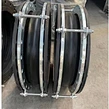

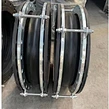
Full Face Flanged Rubber Expansion Joint Connector
DN600-DN2000
The Full Face Flanged Rubber Expansion Joint is a high-performance flexible connector designed to absorb vibration, reduce noise, and compensate for axial, lateral, and angular movements in piping systems. Its distinctive full-face flange design provides a secure, leak-proof seal across the entire contact surface, making it ideal for applications ranging from water supply and HVAC to chemical processing and industrial pipelines.
Delivery
FOB
minimum order
3 pieces
Supply Ability
100pieces / Month
Country of Origin
China
Stock Time
30Day
Quantity:
US $100.00 - US $10000.00 / pieces
## Key Features
**Full-Face Flange Sealing** – The rubber flange covers the entire mating surface of the pipe flange, distributing the sealing force and achieving a superior seal compared to standard gasketed connections.
**Multi-Directional Movement Compensation** – Effectively accommodates axial extension and compression, lateral displacement, and angular deflection caused by thermal expansion, vibration, or system settlement.
**Vibration and Noise Reduction** – The elastomeric body significantly reduces mechanical vibration transmission and dampens water hammer impact, protecting pumps, compressors, and sensitive equipment.
**Corrosion and Chemical Resistance** – Available in a wide range of rubber compounds including EPDM, NBR, Neoprene, Viton/FKM, and Hypalon to resist water, seawater, oils, acids, alkalis, and various chemicals.
**Reinforced Construction** – Multiple layers of high-strength synthetic cord fabric, such as nylon or polyester, embedded in the rubber body provide pressure resistance and structural integrity.
**Wide Size and Pressure Range** – Available from DN15 to DN2000, with larger diameters available on request, and working pressures up to 16 bar or higher depending on design.
## Product Construction
The connector consists of a streamlined rubber bellows body with single or multiple convolutions, fabricated from premium elastomers. The full-face rubber flanges are integral with the body and are backed by metallic backing flanges, available in carbon steel as standard, with hot-dip galvanized steel, stainless steel, or aluminum offered as options. Flanges are drilled to EN, ANSI, ASME, AWWA, JIS, DIN, BS, or custom specifications. Internal reinforcement is provided by multiple layers of high-strength nylon or polyester cord fabric vulcanized into the rubber, and for vacuum service, internal vacuum support rings can be incorporated. Optional accessories include tie rods, limit stops, control rods, covers, and PTFE liners.
## Materials Selection
EPDM rubber offers a temperature range from -40°C to +120°C and provides excellent resistance to water, hot water, brine, steam, and ozone, making it suitable for water systems, HVAC, and air handling applications.
NBR, or Nitrile rubber, operates from -20°C to +100°C and resists oils, fuels, hydrocarbons, and greases, making it ideal for oil handling, fuel lines, and industrial lubrication systems.
Neoprene covers temperatures from -35°C to +100°C with good resistance to seawater, mild chemicals, and weathering, suitable for marine applications and outdoor piping.
FKM, commonly known as Viton, handles temperatures from -20°C to +250°C and provides resistance to chemicals, high-temperature oils, and acids for chemical processing and high-heat environments.
Natural Rubber offers excellent elasticity and abrasion resistance within a range of -30°C to +80°C for industrial water and abrasive media. Hypalon provides resistance to acids, alkalis, ozone, and weathering for chemical and industrial applications. Butyl rubber resists gases and acidic gases with a range of -40°C to +120°C for gas lines and chemical containment.
## Performance Specifications
Nominal diameters are available from DN32 to DN2000 and larger, with working pressures up to 16 bar and burst pressures from 1.8 to 4.5 MPa depending on the model. Vacuum resistance reaches up to 100 kPa with appropriate reinforcement. Axial extension ranges from 6 to 25 millimeters with compression from 10 to 35 millimeters, varying by size. Lateral movement capability spans from 9 to 35 millimeters, and angular deflection ranges from 2 to 30 degrees, again varying by size and design.
## Applications
These expansion joints are widely used in pumping systems to connect pumps to piping, isolating vibration and protecting against misalignment. In HVAC and chilled water systems, they absorb thermal expansion in heating and cooling loops. Water and wastewater treatment facilities employ them in municipal water supply, sewage lines, and treatment plants. The chemical and petrochemical industries utilize them for transferring corrosive fluids and hydrocarbons with appropriately selected rubber compounds. Power generation facilities install them in cooling water systems, steam lines, and industrial utilities. Marine and offshore applications include seawater systems, ballast lines, and dock-side piping, while mining and heavy industry use them for slurry handling, abrasive media, and large-diameter piping.
## Design Standards
The product complies with the Fluid Sealing Association Non-Metallic Expansion Joints Technical Handbook and ASTM F1123-87, the Standard Specification for Non-Metallic Expansion Joints. Certified designs are available to meet the Pressure Equipment Directive 2014/68/EU, and flange drilling follows EN, ANSI, ASME, AWWA, JIS, DIN, or customer-specified patterns.
## Installation Considerations
The full-face design provides enhanced sealing but requires proper flange alignment during installation. For high-pressure or large-diameter installations, fixed supports or anti-pullout devices may be necessary. Unrestrained units must be installed with correctly designed anchors and pipe alignment guides, while restrained designs with tie rods or limit stops can be specified where pressure thrust must be controlled.
**Full-Face Flange Sealing** – The rubber flange covers the entire mating surface of the pipe flange, distributing the sealing force and achieving a superior seal compared to standard gasketed connections.
**Multi-Directional Movement Compensation** – Effectively accommodates axial extension and compression, lateral displacement, and angular deflection caused by thermal expansion, vibration, or system settlement.
**Vibration and Noise Reduction** – The elastomeric body significantly reduces mechanical vibration transmission and dampens water hammer impact, protecting pumps, compressors, and sensitive equipment.
**Corrosion and Chemical Resistance** – Available in a wide range of rubber compounds including EPDM, NBR, Neoprene, Viton/FKM, and Hypalon to resist water, seawater, oils, acids, alkalis, and various chemicals.
**Reinforced Construction** – Multiple layers of high-strength synthetic cord fabric, such as nylon or polyester, embedded in the rubber body provide pressure resistance and structural integrity.
**Wide Size and Pressure Range** – Available from DN15 to DN2000, with larger diameters available on request, and working pressures up to 16 bar or higher depending on design.
## Product Construction
The connector consists of a streamlined rubber bellows body with single or multiple convolutions, fabricated from premium elastomers. The full-face rubber flanges are integral with the body and are backed by metallic backing flanges, available in carbon steel as standard, with hot-dip galvanized steel, stainless steel, or aluminum offered as options. Flanges are drilled to EN, ANSI, ASME, AWWA, JIS, DIN, BS, or custom specifications. Internal reinforcement is provided by multiple layers of high-strength nylon or polyester cord fabric vulcanized into the rubber, and for vacuum service, internal vacuum support rings can be incorporated. Optional accessories include tie rods, limit stops, control rods, covers, and PTFE liners.
## Materials Selection
EPDM rubber offers a temperature range from -40°C to +120°C and provides excellent resistance to water, hot water, brine, steam, and ozone, making it suitable for water systems, HVAC, and air handling applications.
NBR, or Nitrile rubber, operates from -20°C to +100°C and resists oils, fuels, hydrocarbons, and greases, making it ideal for oil handling, fuel lines, and industrial lubrication systems.
Neoprene covers temperatures from -35°C to +100°C with good resistance to seawater, mild chemicals, and weathering, suitable for marine applications and outdoor piping.
FKM, commonly known as Viton, handles temperatures from -20°C to +250°C and provides resistance to chemicals, high-temperature oils, and acids for chemical processing and high-heat environments.
Natural Rubber offers excellent elasticity and abrasion resistance within a range of -30°C to +80°C for industrial water and abrasive media. Hypalon provides resistance to acids, alkalis, ozone, and weathering for chemical and industrial applications. Butyl rubber resists gases and acidic gases with a range of -40°C to +120°C for gas lines and chemical containment.
## Performance Specifications
Nominal diameters are available from DN32 to DN2000 and larger, with working pressures up to 16 bar and burst pressures from 1.8 to 4.5 MPa depending on the model. Vacuum resistance reaches up to 100 kPa with appropriate reinforcement. Axial extension ranges from 6 to 25 millimeters with compression from 10 to 35 millimeters, varying by size. Lateral movement capability spans from 9 to 35 millimeters, and angular deflection ranges from 2 to 30 degrees, again varying by size and design.
## Applications
These expansion joints are widely used in pumping systems to connect pumps to piping, isolating vibration and protecting against misalignment. In HVAC and chilled water systems, they absorb thermal expansion in heating and cooling loops. Water and wastewater treatment facilities employ them in municipal water supply, sewage lines, and treatment plants. The chemical and petrochemical industries utilize them for transferring corrosive fluids and hydrocarbons with appropriately selected rubber compounds. Power generation facilities install them in cooling water systems, steam lines, and industrial utilities. Marine and offshore applications include seawater systems, ballast lines, and dock-side piping, while mining and heavy industry use them for slurry handling, abrasive media, and large-diameter piping.
## Design Standards
The product complies with the Fluid Sealing Association Non-Metallic Expansion Joints Technical Handbook and ASTM F1123-87, the Standard Specification for Non-Metallic Expansion Joints. Certified designs are available to meet the Pressure Equipment Directive 2014/68/EU, and flange drilling follows EN, ANSI, ASME, AWWA, JIS, DIN, or customer-specified patterns.
## Installation Considerations
The full-face design provides enhanced sealing but requires proper flange alignment during installation. For high-pressure or large-diameter installations, fixed supports or anti-pullout devices may be necessary. Unrestrained units must be installed with correctly designed anchors and pipe alignment guides, while restrained designs with tie rods or limit stops can be specified where pressure thrust must be controlled.


