


Metallic Universal Hinged Bellows Expansion Joint
Metallic Universal Hinged Bellows Expansion Joint
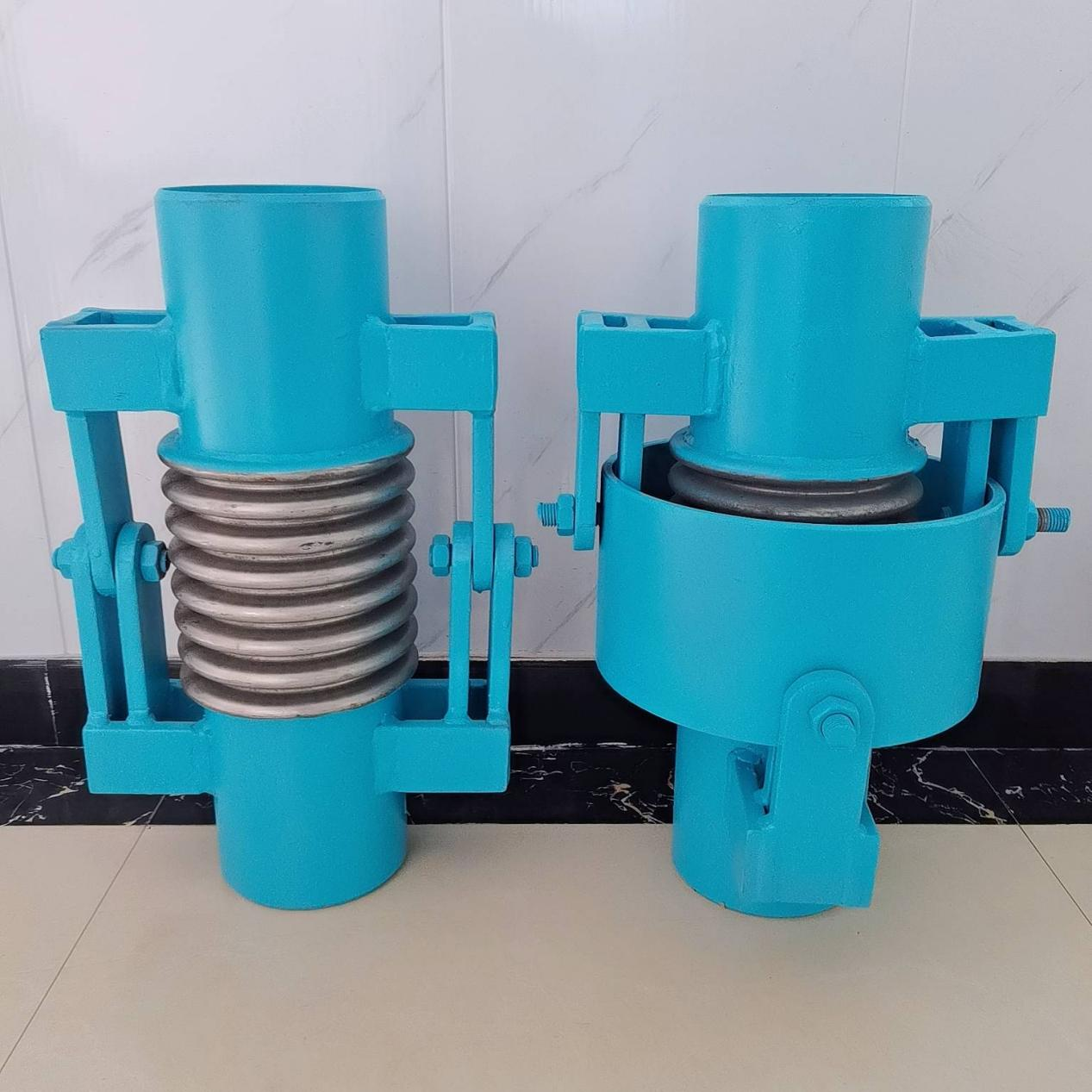
The universal hinged expansion joint is an angular compensator with a"lever"mechanism. Through its ingenious hinge-and-tie-rod mechanical design, it converts angular displacement into axial deformation of the bellows while simultaneously bearing pressure thrust. It is a classic and reliable solution for addressing in-plane thermal bending issues in piping systems.
This is a flexible compensation element used in piping systems, specifically designed to absorb angular displacement within a single plane (i.e., the angular deflection of pipes in the same plane).
Key Structural Components:
1.Bellows: The core component, typically made of multi-ply stainless steel, which absorbs movement through its own elastic deformation.
2.Hinge Plates and Pins: Form the hinge assemblies, which are the key feature distinguishing this type. Usually, two or more sets of hinges are symmetrically arranged on the pipe ends on either side of the bellows. The pins allow the hinge plates to rotate within a specific angle.
3.Tie Rods / Links: Connect the hinge plates on both sides, forming a rigid linkage system. Their functions are:
·To evenly distribute angular displacement to the bellows, preventing distortion.
·To withstand the pressure thrust (blind force) generated by internal pipeline pressure, protecting equipment and ensuring that supports only bear minimal frictional forces.
4.Pipe Ends / Nozzles: Used for welding connection to the pipeline.
Working Principle and Application Scenarios:
·Working Principle:
When the connected pipe sections undergo angular deflection, the rotation of the hinge assemblies and the constraint of the tie rods force the bellows to undergo uniform compression or extension, thereby absorbing the displacement. The tie rod system bears the main internal pressure thrust.
·Primary Application Scenarios:
Angular compensation for"L"-shaped or"Z"-shaped piping systems: This is its most typical application, used to absorb bending deformation in pipes caused by thermal expansion and contraction.
·Situations requiring absorption of significant displacement but with limited installation space.
·Suitable for high-pressure conditions, as its structure can effectively relieve thrust.
·It can only work in one plane (the hinge plane) and cannot absorb axial or lateral movement.
·Typical Industries:
Widely used in high-temperature pipeline systems for steam, gas, hot oil, etc., in thermal power plants, petrochemical plants, steel mills, and marine vessels.
 Universal Lateral Metal Bellows Compensator Suited for High-Pressure High-Flow Conditions
 Customable Universal Flanged Metal Bellows Expansion Joint Compensator
 DN250 Universal Welding Stainless Steel Metal Bellows Expansion Joint Compensator
 Free Double Metal Bellows Expansion Joint, Stainless Steel Corrugated Compensator for Pipeline Thermal Movement