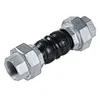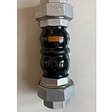
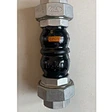
Small Diameter Thread Connection EPDM/NBR Rubber Expansion Joint Connection
Key Design Features
Threaded Union Connection: The joint features internal or external threaded ends (commonly BSPP, BSPT, or NPT) with union nuts, allowing quick and secure installation without welding or flanging. The union design also provides electrical isolation between pipe sections, helping to prevent galvanic corrosion in mixed-metal systems. End fittings are typically made from galvanized malleable iron or ductile iron, with optional stainless steel or bronze unions available for more demanding environments.-3-6
EPDM vs. NBR Rubber Options: The choice of elastomer determines the media compatibility. EPDM offers excellent resistance to water, steam, and weather, making it suitable for HVAC, heating/cooling circuits, and potable water applications. It performs well across a temperature range of approximately -10°C to +110°C in typical service. NBR, on the other hand, provides superior resistance to oils, fuels, and hydrocarbons, with a service range of roughly -40°C to +90°C, making it the preferred choice for oil-handling pipelines and fuel systems. Both materials are reinforced with nylon fabric and steel wire rings to withstand pressure and maintain dimensional stability under movement.-1-3-
Movement and Vibration Absorption: The double-sphere (twin-bulb) bellows geometry is common in threaded designs, enabling the joint to absorb axial compression and extension, lateral offset, and angular deflection simultaneously. Typical movement capabilities for small-diameter units include axial compression of around 20–22 mm, extension of 5–6 mm, lateral displacement of approximately 20–22 mm, and angular deflection of 15°–45° depending on size. The rubber body effectively dampens noise and vibration transmitted from pumps and machinery, protecting downstream equipment.-1-4-7
Technical Specifications (Typical Range)
Exact parameters vary by manufacturer and size. The following reflects common industry values for threaded rubber expansion joints.
The available nominal sizes typically span DN15 to DN80 (1/2"to 3"). The bellows material is EPDM or NBR, nylon-reinforced with steel wire rings. End connections are threaded union, BSPP/BSPT/NPT, in galvanized malleable iron or ductile iron (stainless steel optional). Standard pressure ratings are PN10/PN16 (approximately 10–16 bar), with some manufacturers offering up to 2.5 MPa for certain sizes. Temperature ranges are approximately -10°C to +110°C for EPDM, and -40°C to +90°C for NBR. Movement capabilities cover axial, lateral, and angular displacement. Common accessories include limit rods for pressure thrust restraint where required.
Applications
Threaded rubber expansion joints are widely used in HVAC and plumbing systems, particularly at pump connections in chilled water, heating, and domestic water circuits, where they reduce noise and isolate vibration. In industrial process piping, they serve small-bore lines handling water, air, or non-aggressive fluids. For oil and fuel systems, NBR construction is specified for pump suctions and discharge lines where oil resistance is essential. Water treatment and wastewater plants use them for chemical feed lines and small pump connections. Marine and offshore applications benefit from the compact size and corrosion resistance of available end-fitting materials.
Installation and Selection Notes
When selecting between EPDM and NBR, the primary consideration is the media. EPDM is not recommended for petroleum-based oils or solvents, while NBR should be avoided in strong ozone environments or applications requiring weather resistance. For installations where pressure thrust must be restrained, limit rods or tie rods should be specified; otherwise, the piping system must be adequately anchored to prevent the joint from over-extending under internal pressure. During installation, the joint should not be used to pull misaligned pipe ends together. The threaded unions should be tightened securely, but care must be taken not to over-torque or twist the rubber body. If the joint is installed near a pump, the bellows should be positioned to allow free movement without contact with adjacent structures.