


universal tied expansion joint
The core of a standard metal expansion joint is the bellows, a flexible, corrugated element typically manufactured from high-grade stainless steels, nickel alloys, or other specialized metals. These convolutions allow the joint to compress, extend, and deflect laterally or angularly in response to system dynamics. The specific design—the number of plies, convolution depth, and material thickness—is carefully calculated to handle the required pressure, temperature, and movement ranges.
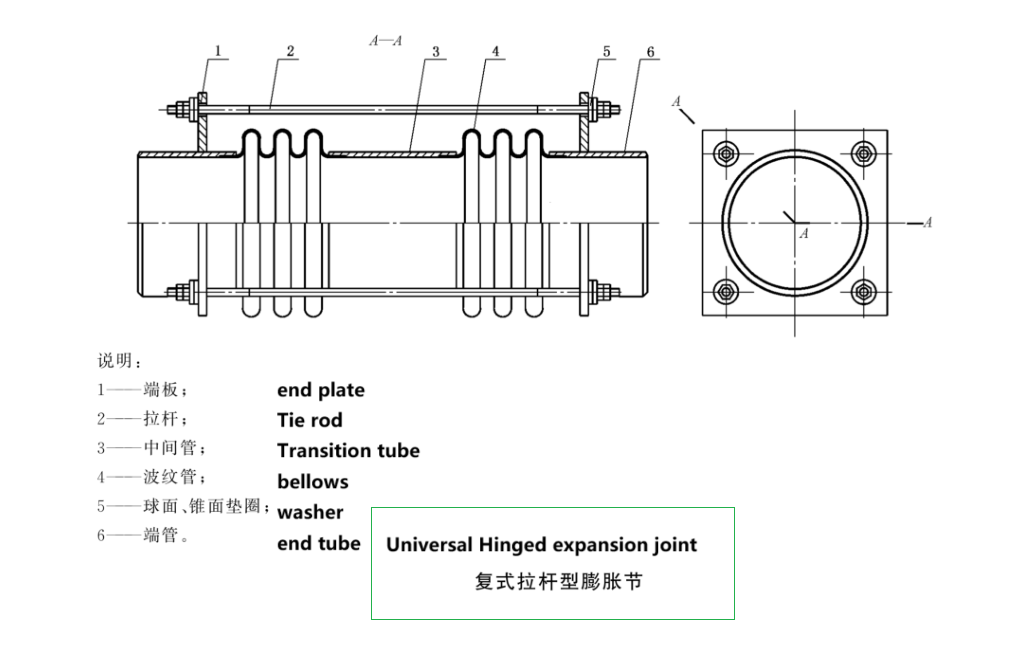
Beyond the basic bellows, expansion joints often incorporate other critical components. End connections, such as flanges or weld ends, facilitate integration into the pipeline. Internal liners can be added to protect the bellows from abrasive media or turbulent flow, while external covers shield the convolutions from physical damage and environmental factors. For high-pressure applications, hinged or gimbal structures are used to restrain the pressure thrust—a powerful force generated by internal pressure acting on the cross-sectional area of the bellows—preventing it from being transferred to adjacent equipment.


