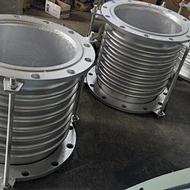
DN1000-DN3000 Metal Bellows Expansion Joint Compensator
DN1000-DN3000
Our DN1000 to DN3000 Metal Bellows Expansion Joint Compensators are precision-engineered flexible connectors designed to absorb thermal expansion, contraction, vibration, and pipe movement in large-diameter industrial piping systems. These heavy-duty compensators are essential components for protecting pipeline infrastructure in demanding applications across power generation, petrochemical, metallurgical, and district heating industries.
Manufactured to the highest standards, these expansion joints accommodate axial, lateral, and angular movements while maintaining system integrity under extreme pressure and temperature conditions.
Manufactured to the highest standards, these expansion joints accommodate axial, lateral, and angular movements while maintaining system integrity under extreme pressure and temperature conditions.
Delivery
FOB
minimum order
1 piece
Supply Ability
30piece / Month
Country of Origin
China
Stock Time
30Day
Quantity:
US $100.00 - US $10000.00 / piece
Key Specifications
Dimensional Range
Dimensional Range
The product line covers nominal diameters from DN1000 through DN3000, equivalent to 40 inches to 120 inches. Custom diameters beyond this range can be accommodated upon request to meet specific project requirements.
Pressure Ratings
Design pressure ranges from 0.25 MPa up to 2.5 MPa as standard, with customized versions available up to 6.4 MPa for high-pressure services. Each unit undergoes hydrostatic testing at 1.5 times the rated working pressure to ensure structural integrity and leak-tight performance.
Temperature Range
The compensators are engineered for operating temperatures spanning from -40°C to +550°C, with the exact range dependent on the selected bellows material. For high-temperature applications exceeding standard limits, special variants are available featuring internal insulation layers and refractory linings to protect the bellows from direct heat exposure.
Movement Capabilities
These expansion joints are designed to accommodate multiple movement types simultaneously. Axial compression and extension can be absorbed within a range of 20 to 50 millimeters per bellows, with customization available for greater stroke requirements. Lateral offset capacity reaches up to 30 millimeters, while angular deflection can be accommodated up to ±15 degrees depending on the specific design configuration.
It is important to note that torsional movement, that is rotation about the pipe axis, is strictly not permissible and must be prevented through proper anchoring and guiding of the pipeline system.
Materials of Construction
Bellows Materials
Bellows Materials
The primary bellows element is available in a selection of high-performance alloys to suit diverse service conditions. Stainless Steel 304 offers good corrosion resistance at a cost-effective price point, making it suitable for general pipeline systems and HVAC applications. Stainless Steel 316L provides enhanced resistance to chlorides and acidic environments, making it ideal for chemical processing, food production, and pharmaceutical industries. Stainless Steel 321 delivers superior resistance to intergranular corrosion and high-temperature oxidation, making it the preferred choice for heat exchangers, boiler connections, and continuous high-temperature services. For critical and harsh environments involving extreme temperatures, aggressive media, or sour gas services, specialty alloys such as Inconel 625, Inconel 800H, or Inconel 825 are available to ensure long-term reliability.
End Connection Materials and Types
Flanges are manufactured from carbon steel, stainless steel, or galvanized steel depending on the service requirements and compatibility with adjoining piping components. Connection options include fixed welding neck flanges for permanent installations, loose or Van Stone flanges for applications requiring easy disassembly and maintenance, and plain welded ends for direct integration into the pipeline without flanged joints.
Construction Features
The bellows can be manufactured as single-ply or multiply construction, with the number of plies selected based on pressure requirements and fatigue life expectations. Reinforcing rings are optionally provided to enhance pressure capacity and prevent buckling under high internal pressures. Internal liners, also known as inner sleeves or flow liners, can be incorporated to protect the bellows from erosion, abrasion, and turbulence, while also ensuring smooth flow direction. External shrouds or protective covers are available for mechanical protection against external damage and for providing a barrier for thermal insulation materials.
Design Standards and Compliance
Every metal bellows expansion joint is designed, manufactured, and rigorously tested in full compliance with leading international codes and standards. The design methodology strictly follows the Expansion Joint Manufacturers Association Standards, specifically the 10th Edition of the EJMA guidelines, which governs all aspects of bellows design including pressure capacity, fatigue life prediction, and movement capability. Additionally, the products are engineered to meet the requirements of ASME B31.3 for process piping systems, ensuring compatibility with global piping design practices. European market requirements are addressed through compliance with EN 14917, the European Standard specifically covering metal bellows expansion joints for pressure applications. The products also conform to the Chinese National Standard GB/T 12777, which provides comprehensive specifications for the design, manufacture, inspection, and testing of metal bellows expansion joints. For pressure-containing components, design and fabrication follow the principles of ASME Boiler and Pressure Vessel Code, Section VIII, Division 1, Appendix 26, ensuring the highest level of safety and reliability.
Every metal bellows expansion joint is designed, manufactured, and rigorously tested in full compliance with leading international codes and standards. The design methodology strictly follows the Expansion Joint Manufacturers Association Standards, specifically the 10th Edition of the EJMA guidelines, which governs all aspects of bellows design including pressure capacity, fatigue life prediction, and movement capability. Additionally, the products are engineered to meet the requirements of ASME B31.3 for process piping systems, ensuring compatibility with global piping design practices. European market requirements are addressed through compliance with EN 14917, the European Standard specifically covering metal bellows expansion joints for pressure applications. The products also conform to the Chinese National Standard GB/T 12777, which provides comprehensive specifications for the design, manufacture, inspection, and testing of metal bellows expansion joints. For pressure-containing components, design and fabrication follow the principles of ASME Boiler and Pressure Vessel Code, Section VIII, Division 1, Appendix 26, ensuring the highest level of safety and reliability.
Product Types and Configurations
Based on the specific movement requirements and system constraints of each application, our DN1000 to DN3000 expansion joints are offered in several distinct configurations.
Based on the specific movement requirements and system constraints of each application, our DN1000 to DN3000 expansion joints are offered in several distinct configurations.
Axial Expansion Joints represent the most commonly specified configuration for large-diameter pipelines. These are designed primarily to absorb axial movement along the pipe centerline. It is important to note that axial expansion joints do not restrain pressure thrust forces, meaning the pipeline system must be properly designed with main anchors and pipe guides to manage these thrust loads.
Lateral Expansion Joints are engineered to accommodate transverse or lateral movement, where the pipe shifts perpendicular to its axis. These are often available with gimbal or hinge assemblies that guide the motion and prevent undesirable movement directions while allowing controlled lateral deflection.
Angular Expansion Joints are intended for applications requiring angular rotation of the piping system. Hinged designs restrict movement to a single plane of rotation, while gimbal designs permit rotation in any plane, offering greater flexibility for complex piping arrangements.
Universal Expansion Joints combine two or more bellows connected by an intermediate pipe section. This configuration enables the simultaneous absorption of large axial, lateral, and angular movements, making them ideal for long piping runs with significant thermal expansion demands.
Pressure-Balanced Expansion Joints incorporate a unique design that cancels pressure thrust forces internally, eliminating the need for heavy main anchors. This configuration is particularly advantageous when space constraints or structural limitations prevent the installation of robust anchoring systems, or when connecting to sensitive equipment such as turbines, compressors, or pumps where thrust loads must be minimized.