
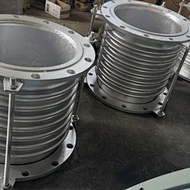

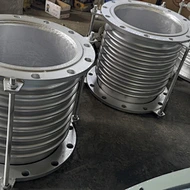
PTFE lined stainless steel metal expansion joint
DN100-DN500
PTFE lined stainless steel metal expansion joint is a corrosion-resistant flexible piping compensator constructed with stainless steel outer bellows and integral PTFE inner lining. The stainless steel body provides structural strength, pressure resistance and flexibility to absorb axial, lateral and angular displacement, while the seamless PTFE lining isolates the medium from metal substrate. It resists strong acids, alkalis, solvents and corrosive chemicals, eliminating metal corrosion and medium contamination. Equipped with flanges or weld ends for easy pipeline connection, it is widely applied in chemical, pharmaceutical, electroplating and waste treatment pipelines conveying highly corrosive media, working stably under wide temperature and pressure ranges.
Delivery
EXW
minimum order
1 piece
Supply Ability
100piece / Day
Country of Origin
CHINA
Stock Time
14Day
Quantity:
US $20.00 - US $1000.00 / piece
PTFE Lined Stainless Steel Metal Expansion Joint
1. Product Overview
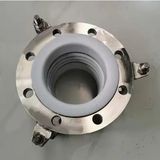
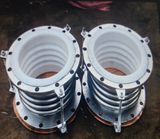
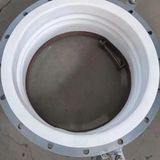
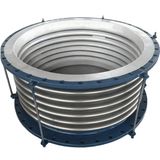
PTFE lined stainless steel metal expansion joint is a special anti-corrosion flexible compensation product independently developed for harsh corrosive medium pipelines in modern industrial production. Ordinary stainless steel metal expansion joints are prone to chemical corrosion when transporting acid, alkali and strong oxidizing media, which leads to bellows perforation, pipeline leakage and system shutdown. In order to solve this industry pain point, manufacturers adopt a composite forming process to add a seamless PTFE lining inside stainless steel bellows, combining the mechanical flexibility of metal materials and the ultra-strong corrosion resistance of PTFE.
The outer stainless steel corrugated bellows serves as the main stress-bearing structure of the whole product. It relies on its unique corrugated structure to obtain good elastic deformation capacity. During pipeline operation, thermal expansion and cold contraction, foundation settlement and construction installation errors will produce various displacement changes. This expansion joint can effectively absorb axial stretch and compression, lateral dislocation and angular deflection, disperse the concentrated stress of the pipeline, avoid damage to pumps, valves, reaction kettles and other key equipment, and improve the overall safety of the piping system.
2. Structural Composition and Material Characteristics
The product is mainly composed of three core parts: stainless steel bellows main body, integral seamless PTFE lining and pipeline connecting ends. The stainless steel bellows usually selects 304 or 316L stainless steel with excellent pressure resistance and temperature resistance, which can bear the internal pressure of the medium and provide structural support for the inner lining. The wave shape of the bellows is designed through mechanical calculation to ensure balanced compensation capacity and tensile strength without cracking under long-term repeated deformation.
The inner lining adopts integrated seamless PTFE molding technology without splicing gaps. As a typical chemically inert material, PTFE hardly reacts with any strong acid, strong alkali, organic solvent, chlorine-containing medium and oxidant within the applicable temperature range. The completely covered lining isolates all corrosive fluid from the metal surface of the bellows, fundamentally preventing electrochemical corrosion and chemical erosion of stainless steel. Besides anti-corrosion, the ultra-smooth inner wall of PTFE also reduces fluid friction resistance, prevents viscous medium from adhering and scaling on the pipe wall, and keeps the pipeline conveying efficiency stable for a long time.
Flange or butt-weld ends are set at both ends of the expansion joint. Flange ends are convenient for disassembly and maintenance, suitable for pipelines requiring frequent inspection; butt-weld ends realize fully sealed connection, which is more suitable for high-pressure and high-temperature closed production lines. All connecting ends are made of the same stainless steel material as the bellows to avoid galvanic corrosion caused by different metal matching.
3. Core Performance Advantages
First of all, it has all-round anti-corrosion performance that ordinary metal expansion joints cannot match. It can adapt to almost all corrosive chemical media, and there is no risk of lining falling off or cracking under normal working conditions, greatly extending the service life of the compensation part. Secondly, it retains all the flexible compensation functions of stainless steel expansion joints, and will not lose the ability to absorb pipeline displacement due to the addition of PTFE lining.
In addition, the PTFE lining has excellent non-stick property, which is very friendly for the production of pharmaceutical, food and fine chemical industries. It will not pollute the conveying medium, and effectively avoid the mixing of metal ions into raw materials to affect product purity. Meanwhile, the product has a wide applicable temperature range, and can maintain stable performance under low-temperature refrigeration and medium-temperature heating working conditions, with strong adaptability to complex production environments.
4. Application Scope of Products
This series of expansion joints are widely used in industrial pipelines that need to transport highly corrosive media. In the chemical industry, it can be used for acid-base reaction pipelines, solvent delivery pipelines and waste liquid discharge pipelines; in the pharmaceutical industry, it is applied to the conveying pipeline of pharmaceutical raw materials and purified water to ensure the cleanliness of materials; in the electroplating industry, it matches the corrosive plating solution circulation pipeline to solve the problem of rapid corrosion of ordinary pipe fittings.
It also plays an important role in environmental protection wastewater treatment, new energy material processing, pesticide manufacturing and other fields. For production lines with high requirements on pipeline safety and medium purity, PTFE lined stainless steel metal expansion joint has become a standard supporting pipe fitting. Compared with rubber expansion joints and plastic expansion joints, it has higher pressure resistance and temperature resistance, and can adapt to more severe high-pressure industrial pipeline working conditions.
5. Installation and Acceptance Key Points
During installation, the product must be kept in a natural free state, and forced stretching, compression or twisting is prohibited to avoid damage to the internal PTFE lining and affect the compensation effect. When fixing the flanges, the bolts shall be tightened symmetrically and evenly to prevent uneven stress from causing local cracking of the PTFE layer. Before putting into operation, it is necessary to check whether there is lining separation, bulge and damage on the inner wall to ensure the tight combination between PTFE and stainless steel bellows.
In routine inspection, focus on observing whether there is medium leakage at the wave crests and connection ends of the bellows. Once leakage occurs, stop operation in time for inspection. Reasonable installation and regular maintenance can maximize the service cycle of the PTFE lined stainless steel metal expansion joint and reduce the replacement frequency of pipeline accessories.


