
Comparison of Fatigue Life: Single Layer 1.2mm vs Double Layer 0.6mm DN300 Bellows (Without Inner Liner)
author: Siyu Li
2026-06-18
 VS
VS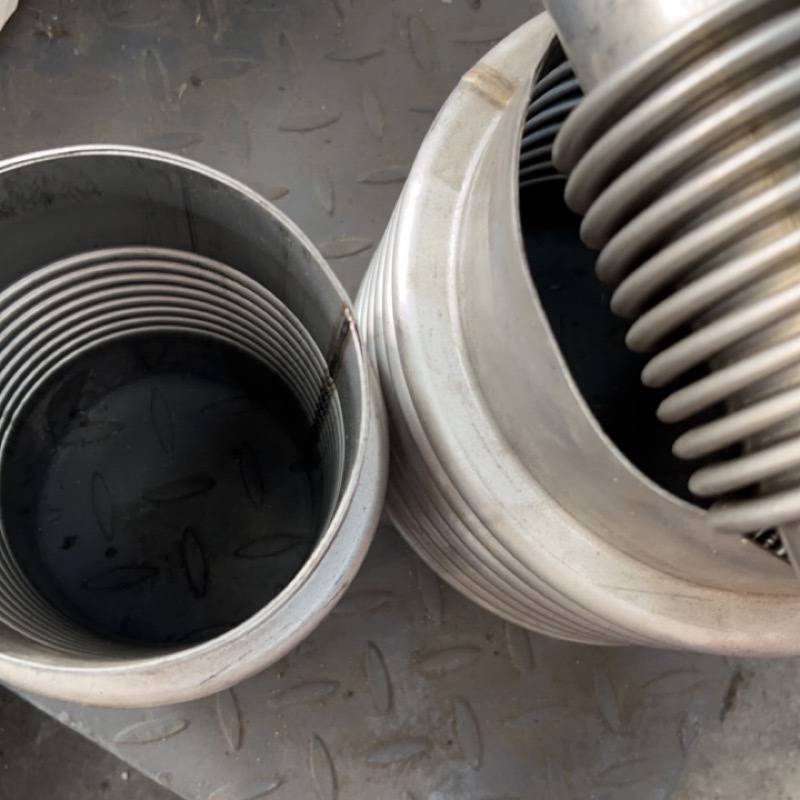
1. Fundamental Mechanical Principle of Fatigue Performance
1. Single-layer 1.2mm bellows
Formed from a single thick plate of 1.2mm. High strain concentration occurs at wave roots and valleys during expansion & contraction. The plastic strain generated per reciprocating cycle is large with high peak stress, which easily initiates fatigue cracks under cyclic alternating loads.
Formed from a single thick plate of 1.2mm. High strain concentration occurs at wave roots and valleys during expansion & contraction. The plastic strain generated per reciprocating cycle is large with high peak stress, which easily initiates fatigue cracks under cyclic alternating loads.
2. Double-layer bellows (two layers of 0.6mm each)
Each thin sheet is only 0.6mm, resulting in much lower residual forming stress. The two layers slide against each other to share deformation during displacement. Strain borne by each individual layer is halved, and peak stress is greatly reduced. Under the same displacement and pressure cycles, the cycle count before fatigue crack formation increases drastically.
Each thin sheet is only 0.6mm, resulting in much lower residual forming stress. The two layers slide against each other to share deformation during displacement. Strain borne by each individual layer is halved, and peak stress is greatly reduced. Under the same displacement and pressure cycles, the cycle count before fatigue crack formation increases drastically.
With equal total metal thickness, industry test data proves the fatigue cycle life of double-layer thin-wall structure is 2 to 4 times longer than single thick-wall bellows; 3 times is the common engineering estimation value.
2. Quantified Fatigue Life Gap by Working Conditions (DN300, no inner liner)
Condition 1: Clean medium without solid particles (only alternating vibration & expansion considered, no interlayer corrosion)
Standard fatigue test under rated displacement and constant pressure:
• Single layer 1.2mm: Failure after 100,000 ~ 200,000 cycles
• Double layer 2×0.6mm: Failure after 300,000 ~ 600,000 cycles
→ Fatigue service life increased by 2 ~ 3 times. Outstanding performance for pump inlet/outlet and fan pipelines with continuous vibration.
→ Fatigue service life increased by 2 ~ 3 times. Outstanding performance for pump inlet/outlet and fan pipelines with continuous vibration.
Condition 2: Medium containing sediment, welding slag or impurities (Negative impact of no inner liner)
Without inner liner, fluid directly impacts wave valleys, and solid particles will enter the gap between two layers, bringing two severe drawbacks:
1. Fretting wear occurs between two laminated surfaces under repeated friction, generating tiny microcracks.
2. Liquid trapped in interlayer triggers galvanic corrosion, thinning wall thickness rapidly and accelerating fatigue failure.
Actual service life attenuation on site:
Actual service life attenuation on site:
• Slight solid impurity content: Double-layer fatigue life only 1.5 ~ 2 times that of single layer
• Heavy sediment or high-temperature steam scouring: Interlayer corrosion & wear further weaken its advantage, only 1.2 ~ 1.5 times longer. In extreme harsh conditions, the overall service life of double-layer bellows may even be inferior to single-layer type.
Condition 3: Low reciprocating displacement & mild vibration
Small thermal expansion and slight pipeline vibration narrow the fatigue performance gap. Double-layer life is merely 1.5 ~ 2 times of single-layer. Due to better anti-scouring capacity, single-layer 1.2mm bellows have longer comprehensive actual service life.
Condition 4: Large displacement & frequent reciprocating motion (pump connections, frequent foundation settlement displacement)
Continuous equipment vibration with tens of thousands of expansion cycles daily:
Without medium erosion, the fatigue life of double-layer bellows reaches 3 ~ 4 times that of single layer, which is the core advantage of multi-layer bellows.
Without medium erosion, the fatigue life of double-layer bellows reaches 3 ~ 4 times that of single layer, which is the core advantage of multi-layer bellows.
3. Critical Note: Fatigue Life ≠ Total Comprehensive Service Life
• If only evaluating fatigue cracking resistance under alternating loads: Double-layer 0.6mm bellows perform far better, with 1.5 ~ 4 times longer fatigue life depending on medium cleanliness.
• If calculating total service life integrating scouring, corrosion and fatigue (DN300 without inner liner):
◦ Clean cold water & pure gas: Double-layer bellows have longer overall service life.
◦ Steam, sewage or particle-laden medium: Single-layer 1.2mm integrated structure has no interlayer gap, avoiding delamination and leakage risks, so its actual usable years are longer despite weaker fatigue resistance.
4. Concise Engineering Conclusion (For customer communication)
1. If only focusing on anti-fatigue cycle performance and ignoring medium scouring & corrosion: The fatigue life of double-layer 0.6mm bellows is 2 ~ 3 times that of single-layer 1.2mm, and up to 4 times under heavy vibration & large displacement working conditions.
2. For DN300 bellows without inner liner conveying impurity-laden or steam medium, interlayer wear & corrosion weaken its fatigue advantage, only 1.2 ~ 1.5 times longer than single layer.
3. Prioritize single-layer bellows for severe scouring applications. Although its fatigue cycle endurance is lower, no delamination leakage risk ensures longer practical service life.
Standard No. CJ/T 487-2015 Fabricated Sleeve Compensators for Urban Heating Pipelines
Why Tie Rods Are Mandatory for Lateral Double Bellows Expansion Joints?
Related Article

Internal‑pressure bellows: medium inside bellows, inner liner inside, tie‑rods needed for large displacement.
External‑pressure bellows: medium outside bellows, nested sleeve structure, good anti‑instability, tie‑rods normally not required.
External‑pressure bellows: medium outside bellows, nested sleeve structure, good anti‑instability, tie‑rods normally not required.
Internal‑pressure vs External‑pressure Metal Bellows Expansion Joints ?

NBR rubber expansion joints fail in high-temperature thermal oil systems because thermal oil runs above 300°C, while NBR can only handle ~90–140°C. This extreme heat causes rapid oil-swelling (softening and seal failure) and thermo-oxidative aging (hardening and cracking). The joint quickly fails, leading to thermal oil leaks and fire hazards. Use stainless steel or specially insulated expansion joints instead.
Why NBR Rubber Expansion Joints Cannot Be Used in High-Temperature Thermal Oil Systems
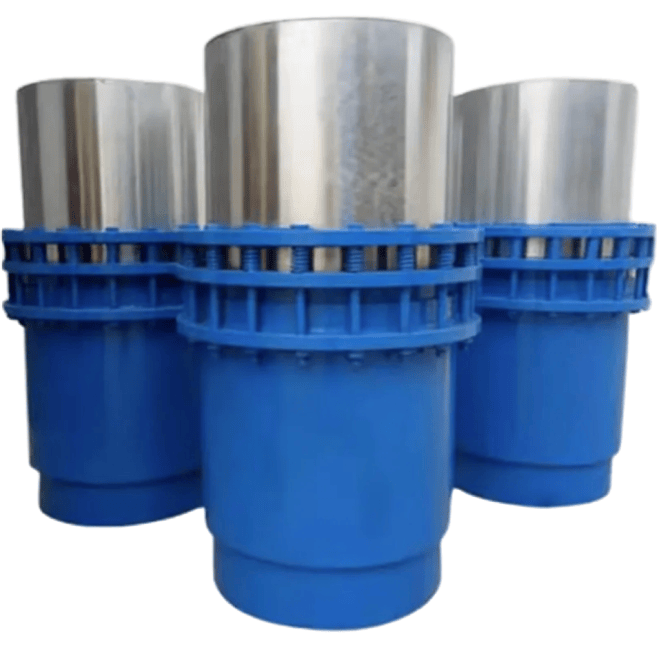
When selecting pipeline expansion components, many engineering purchasers and designers notice a common phenomenon: stock sleeve expansion joints on the market mostly adopt 200 mm as the basic axial compensation stroke, while the single-unit compensation capacity of conventional bellows expansion joints generally ranges from 50 mm to 120 mm. This difference is jointly determined by product principles, application scenarios and production economy.
Why Do Sleeve Expansion Joints Generally Start With a Compensation Capacity of 200 mm?

The counter-flange inner diameter is smaller than the expansion joint's flange bore to: fully compress the rubber sealing surface and prevent leaks, avoid sharp edges cutting the rubber during vibration, and act as a retaining ring to prevent pull-out accidents. This protects the rubber and ensures safety—always use matching flanges during installation.
Technical Explanation: Why Is the Inner Diameter of the Matching Counter-Flange Often Smaller Than That of the Rubber Expansion Joint's Own Flange?