
Internal‑pressure vs External‑pressure Metal Bellows Expansion Joints ?
author: Zhimin Yang
2021-07-14

Internal‑pressure vs External‑pressure Metal Bellows Expansion Joints
Structural Differences


1. Pressure direction
• Internal‑pressure type: Fluid pressure acts from inside the bellows outwards.
• External‑pressure type: Fluid pressure acts on the outer surface of the bellows and compresses the bellows inward.
2. Inner liner / guide sleeve
• Internal‑pressure: The inner liner is fitted inside the bellows to protect bellows from medium erosion.
• External‑pressure: Adopts nested‑sleeve construction. The protective sleeve is arranged outside the bellows.
3. Anti‑instability performance & tie‑rod
• Internal‑pressure: Prone to column instability for large compensation travel. Tie‑rods are mandatory for long‑stroke versions.
• External‑pressure: Inherently good resistance to column instability. Tie‑rods are generally not required.
4. Typical application
• Internal‑pressure: Short‑to‑medium pipeline sections, common steam, water and oil pipelines.
• External‑pressure: Long‑distance buried heating pipelines, pipelines requiring large compensation capacity.

Why NBR Rubber Expansion Joints Cannot Be Used in High-Temperature Thermal Oil Systems
Related Article

NBR rubber expansion joints fail in high-temperature thermal oil systems because thermal oil runs above 300°C, while NBR can only handle ~90–140°C. This extreme heat causes rapid oil-swelling (softening and seal failure) and thermo-oxidative aging (hardening and cracking). The joint quickly fails, leading to thermal oil leaks and fire hazards. Use stainless steel or specially insulated expansion joints instead.
Why NBR Rubber Expansion Joints Cannot Be Used in High-Temperature Thermal Oil Systems
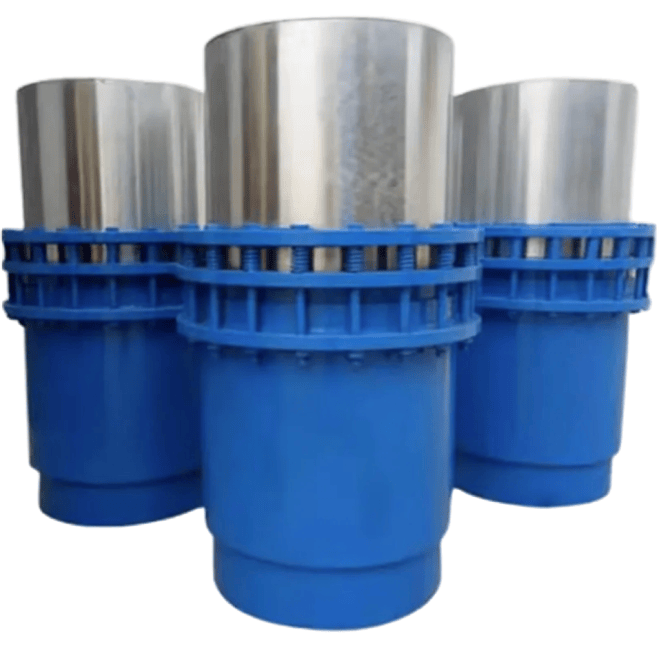
When selecting pipeline expansion components, many engineering purchasers and designers notice a common phenomenon: stock sleeve expansion joints on the market mostly adopt 200 mm as the basic axial compensation stroke, while the single-unit compensation capacity of conventional bellows expansion joints generally ranges from 50 mm to 120 mm. This difference is jointly determined by product principles, application scenarios and production economy.
Why Do Sleeve Expansion Joints Generally Start With a Compensation Capacity of 200 mm?

The counter-flange inner diameter is smaller than the expansion joint's flange bore to: fully compress the rubber sealing surface and prevent leaks, avoid sharp edges cutting the rubber during vibration, and act as a retaining ring to prevent pull-out accidents. This protects the rubber and ensures safety—always use matching flanges during installation.
Technical Explanation: Why Is the Inner Diameter of the Matching Counter-Flange Often Smaller Than That of the Rubber Expansion Joint's Own Flange?
