
Why NBR Rubber Expansion Joints Cannot Be Used in High-Temperature Thermal Oil Systems
author: LIUNA
2026-05-19

In industrial piping systems, rubber expansion joints are widely used to absorb thermal displacement and reduce equipment vibration due to their excellent flexibility and damping properties. Nitrile rubber (NBR), owing to its outstanding oil resistance, is often considered for piping connections involving oily media. However, in high-temperature thermal oil systems, using NBR expansion joints is a serious selection error—one that not only leads to rapid equipment failure but also poses significant safety hazards.
1. The Temperature Gap: NBR's Thermal Limit vs. Thermal Oil Operating Temperatures
The operating temperature of NBR rubber has clear physical limitations. Conventional NBR expansion joints have a service temperature range of -40°C to +90°C, and even high-temperature grade NBR products with specially optimized formulations can only withstand up to +140°C. Even under special conditions where instantaneous tolerance may reach 100°C, this remains far below the operational requirements of thermal oil systems.
The operating temperature of NBR rubber has clear physical limitations. Conventional NBR expansion joints have a service temperature range of -40°C to +90°C, and even high-temperature grade NBR products with specially optimized formulations can only withstand up to +140°C. Even under special conditions where instantaneous tolerance may reach 100°C, this remains far below the operational requirements of thermal oil systems.
In contrast, thermal oil systems typically operate at temperatures above 300°C, and often even higher. There is a vast temperature gap of more than 160°C between the two. When high-temperature thermal oil comes into direct contact with NBR expansion joints, the rubber material rapidly exceeds its thermal limit, triggering a series of irreversible physicochemical changes.
2. High Temperatures Accelerate Rubber Swelling, Leading to Seal Failure
The oil resistance of NBR rubber derives from the polar nitrile groups (-CN) in its molecular chains, which provide good resistance to non-polar and weakly polar oils. However, this property is significantly compromised under high-temperature conditions.
The oil resistance of NBR rubber derives from the polar nitrile groups (-CN) in its molecular chains, which provide good resistance to non-polar and weakly polar oils. However, this property is significantly compromised under high-temperature conditions.
Research has shown that temperature is a critical factor affecting the swelling rate of rubber. When NBR is immersed in hot oil, oil molecules gradually diffuse into the cross-linked three-dimensional network structure of the rubber, increasing the spacing between molecular chains and enhancing chain segment mobility. As temperature rises, the rubber molecular chain segments become more flexible, while oil molecules become less viscous and more active, resulting in significantly increased penetration.
This swelling process leads to severe consequences:
Sharp deterioration of mechanical properties: After immersion in hot oil at 55°C for 42 days, the elastic strain energy density of NBR drops to 3% of its initial value, and hardness decreases by 85%—essentially losing all load-bearing capacity.
Rubber softening and loss of strength: The penetration of oil molecules reduces the intermolecular interactions within the rubber polymer chains, causing chain disentanglement and swelling, which severely softens the rubber and diminishes its elasticity and strength.
Leaching of additives: Plasticizers and other additives within the rubber gradually leach out and dissolve into the oil at elevated temperatures, further accelerating material degradation.
This means that in high-temperature thermal oil environments, NBR expansion joints will continuously absorb oil and swell like a sponge, while simultaneously losing their original strength and elasticity, ultimately leading to sealing surface failure and media leakage.
3. Molecular Chain Thermo-Oxidative Aging Accelerates Material Embrittlement
In addition to swelling issues, the high-temperature environment itself causes thermo-oxidative aging of NBR rubber. Although NBR exhibits better heat resistance than natural rubber and styrene-butadiene rubber due to its acrylonitrile content, its maximum service temperature is still only around 130°C. When temperatures far exceed this limit, the rubber molecular chains undergo oxidative chain scission and further cross-linking, causing the material to gradually become hard, brittle, and lose its flexibility.
In addition to swelling issues, the high-temperature environment itself causes thermo-oxidative aging of NBR rubber. Although NBR exhibits better heat resistance than natural rubber and styrene-butadiene rubber due to its acrylonitrile content, its maximum service temperature is still only around 130°C. When temperatures far exceed this limit, the rubber molecular chains undergo oxidative chain scission and further cross-linking, causing the material to gradually become hard, brittle, and lose its flexibility.
The core function of expansion joints is to absorb thermal displacement and vibration of pipes, which requires the main material to maintain excellent flexibility and elastic recovery. Thermo-oxidative aging causes NBR expansion joints to lose these critical properties. Under the repeated cyclic stresses of pipe expansion and contraction, the brittle rubber bellows are prone to cracking, ultimately leading to thermal oil leakage.
4. Engineering Practice Evidence and Alternative Solutions
Evidence from industry practice further validates this conclusion. Product data from various expansion joint manufacturers consistently states that NBR expansion joints are "not suitable for steam and hot water". Moreover, in piping specifications involving high-temperature media, the bellows material for expansion joints is typically required to be S31603 stainless steel or higher-grade alloy materials.
Evidence from industry practice further validates this conclusion. Product data from various expansion joint manufacturers consistently states that NBR expansion joints are "not suitable for steam and hot water". Moreover, in piping specifications involving high-temperature media, the bellows material for expansion joints is typically required to be S31603 stainless steel or higher-grade alloy materials.
For thermal oil systems, the industry has established mature solutions: thermal oil-specific flexible expansion joints use multi-layer stainless steel combined with high-temperature resistant fiber composite materials, capable of withstanding temperatures above 300°C; their internal linings typically use PTFE (polytetrafluoroethylene) or specialty rubbers to ensure no chemical reaction with thermal oil during long-term service. Additionally, patented technologies incorporate internal guide cylinders, insulation packing, and water-cooling structures to maintain the rubber section's operating temperature below 100°C, thereby enabling them to withstand fluid temperatures exceeding 1000°C.
Conclusion
The fundamental reason why NBR rubber expansion joints cannot be used in high-temperature thermal oil systems is that the temperature limit of NBR (approximately 90–140°C) is far below the operating temperature of thermal oil systems (typically above 300°C). In a hot oil environment far exceeding its tolerance, NBR suffers from the combined destructive effects of accelerated swelling by hot oil and thermo-oxidative aging—the former causing the rubber to lose strength and elasticity, and the latter making it hard and brittle. Together, these mechanisms cause the expansion joint to lose both its sealing function and displacement compensation capability within a short period, resulting in thermal oil leakage and posing severe risks of fire, equipment damage, and personal injury.
The fundamental reason why NBR rubber expansion joints cannot be used in high-temperature thermal oil systems is that the temperature limit of NBR (approximately 90–140°C) is far below the operating temperature of thermal oil systems (typically above 300°C). In a hot oil environment far exceeding its tolerance, NBR suffers from the combined destructive effects of accelerated swelling by hot oil and thermo-oxidative aging—the former causing the rubber to lose strength and elasticity, and the latter making it hard and brittle. Together, these mechanisms cause the expansion joint to lose both its sealing function and displacement compensation capability within a short period, resulting in thermal oil leakage and posing severe risks of fire, equipment damage, and personal injury.
Therefore, in the selection of expansion joints for high-temperature thermal oil systems, NBR rubber must be abandoned in favor of stainless steel metal expansion joints or specially insulated rubber expansion joints, to ensure the long-term safe and stable operation of the system.
Internal‑pressure vs External‑pressure Metal Bellows Expansion Joints ?
Why Do Sleeve Expansion Joints Generally Start With a Compensation Capacity of 200 mm?
Related Article

Internal‑pressure bellows: medium inside bellows, inner liner inside, tie‑rods needed for large displacement.
External‑pressure bellows: medium outside bellows, nested sleeve structure, good anti‑instability, tie‑rods normally not required.
External‑pressure bellows: medium outside bellows, nested sleeve structure, good anti‑instability, tie‑rods normally not required.
Internal‑pressure vs External‑pressure Metal Bellows Expansion Joints ?
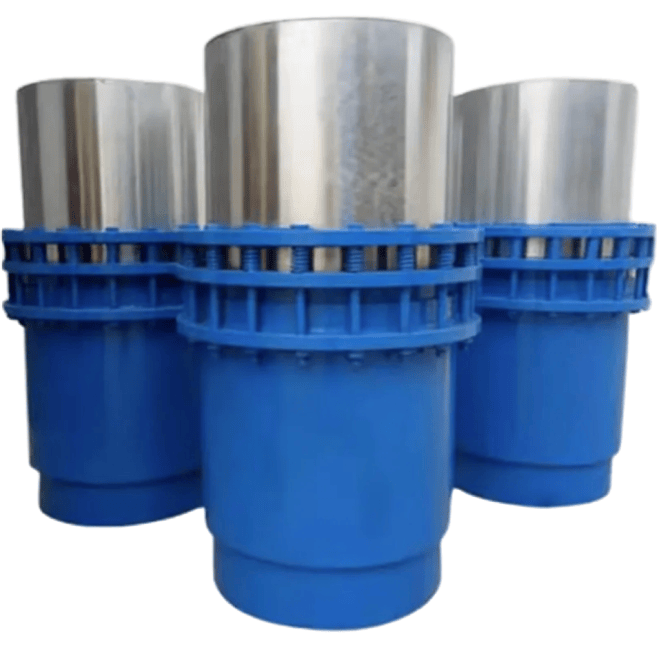
When selecting pipeline expansion components, many engineering purchasers and designers notice a common phenomenon: stock sleeve expansion joints on the market mostly adopt 200 mm as the basic axial compensation stroke, while the single-unit compensation capacity of conventional bellows expansion joints generally ranges from 50 mm to 120 mm. This difference is jointly determined by product principles, application scenarios and production economy.
Why Do Sleeve Expansion Joints Generally Start With a Compensation Capacity of 200 mm?

The counter-flange inner diameter is smaller than the expansion joint's flange bore to: fully compress the rubber sealing surface and prevent leaks, avoid sharp edges cutting the rubber during vibration, and act as a retaining ring to prevent pull-out accidents. This protects the rubber and ensures safety—always use matching flanges during installation.
Technical Explanation: Why Is the Inner Diameter of the Matching Counter-Flange Often Smaller Than That of the Rubber Expansion Joint's Own Flange?
