
Why Must Flanged Rubber Joints Be Fitted with Vacuum Rings?
author: Liuna
2026-06-02

## Negative Pressure: The "Invisible Killer" of Rubber Joints
The forces exerted by pipeline media on rubber joints can be divided into two types: positive pressure and negative pressure. Positive pressure arises from the forward thrust of the flowing medium, while negative pressure results from the suction force created when air inside the pipeline is rapidly depleted. Such vacuum conditions commonly occur at the inlet and outlet of pumps, or during the instantaneous opening and closing of valve discs, at which point a powerful suction force acts upon the rubber joint.
Although the wide flanged design of these joints endows them with exceptional pull-out resistance, they possess an inherent shortcoming when it comes to withstanding negative pressure. When internal vacuum levels become excessive, the rubber body—unable to resist external atmospheric pressure—collapses inward. This collapse leads to a drastic reduction in the cross-sectional area of the pipeline, obstructing medium flow, and may even cause permanent damage to the joint, posing a serious threat to overall system safety.
## Vacuum Rings: The Key to Overcoming Collapse
So, how can the negative-pressure resistance of flanged rubber joints be enhanced? The engineering solution is the incorporation of vacuum rings. Typically fabricated from multiple strands of copper-plated steel wire or other rigid metallic materials, these rings have an inner diameter closely matching that of the rubber joint and are pre-inserted into the spherical body prior to assembly.
The core principle behind this design is to provide a sturdy "skeletal support" for the otherwise flexible rubber body. When negative pressure develops inside the pipeline, the internal vacuum ring uses its structural rigidity to counteract external atmospheric pressure, preventing the rubber from deforming inward and thereby effectively avoiding collapse. With the vacuum ring installed, the rubber joint not only achieves a significant safety improvement, but also demonstrates markedly enhanced practicality and durability under vacuum conditions.
## Coordinated Protection: Building a "Safety Net" for High-Pressure Systems
It is worth noting that in high-pressure or high-vibration pipeline systems, vacuum rings rarely operate in isolation. For demanding environments that simultaneously involve high pressure, strong tensile forces, and negative pressure, engineers typically implement multiple protective measures. In addition to installing internal vacuum rings to prevent collapse, anti-pull-out devices and limit tie-rods are added at the flange connections.
This coordinated protection mechanism enables pressure distribution: a portion of the stress is absorbed by the vacuum ring, while the tensile forces are managed by the anti-pull-out devices. As a result, the rubber joint body is subjected only to stresses within its designed tolerance, significantly reducing the risks of pull-out, fracture, and collapse. For pump stations, water supply systems, and HVAC installations that demand long-term, stable operation under complex hydraulic conditions, this integrated design has become a standard specification.
## Conclusion
In summary, the addition of vacuum rings to flanged rubber joints is by no means optional—it is an effective technical countermeasure against the hazards of pipeline negative pressure. By providing internal structural reinforcement, the vacuum ring enhances the joint's overall strength and ensures the safety and stability of pipeline connections under challenging operating conditions.
The forces exerted by pipeline media on rubber joints can be divided into two types: positive pressure and negative pressure. Positive pressure arises from the forward thrust of the flowing medium, while negative pressure results from the suction force created when air inside the pipeline is rapidly depleted. Such vacuum conditions commonly occur at the inlet and outlet of pumps, or during the instantaneous opening and closing of valve discs, at which point a powerful suction force acts upon the rubber joint.
Although the wide flanged design of these joints endows them with exceptional pull-out resistance, they possess an inherent shortcoming when it comes to withstanding negative pressure. When internal vacuum levels become excessive, the rubber body—unable to resist external atmospheric pressure—collapses inward. This collapse leads to a drastic reduction in the cross-sectional area of the pipeline, obstructing medium flow, and may even cause permanent damage to the joint, posing a serious threat to overall system safety.
## Vacuum Rings: The Key to Overcoming Collapse
So, how can the negative-pressure resistance of flanged rubber joints be enhanced? The engineering solution is the incorporation of vacuum rings. Typically fabricated from multiple strands of copper-plated steel wire or other rigid metallic materials, these rings have an inner diameter closely matching that of the rubber joint and are pre-inserted into the spherical body prior to assembly.
The core principle behind this design is to provide a sturdy "skeletal support" for the otherwise flexible rubber body. When negative pressure develops inside the pipeline, the internal vacuum ring uses its structural rigidity to counteract external atmospheric pressure, preventing the rubber from deforming inward and thereby effectively avoiding collapse. With the vacuum ring installed, the rubber joint not only achieves a significant safety improvement, but also demonstrates markedly enhanced practicality and durability under vacuum conditions.
## Coordinated Protection: Building a "Safety Net" for High-Pressure Systems
It is worth noting that in high-pressure or high-vibration pipeline systems, vacuum rings rarely operate in isolation. For demanding environments that simultaneously involve high pressure, strong tensile forces, and negative pressure, engineers typically implement multiple protective measures. In addition to installing internal vacuum rings to prevent collapse, anti-pull-out devices and limit tie-rods are added at the flange connections.
This coordinated protection mechanism enables pressure distribution: a portion of the stress is absorbed by the vacuum ring, while the tensile forces are managed by the anti-pull-out devices. As a result, the rubber joint body is subjected only to stresses within its designed tolerance, significantly reducing the risks of pull-out, fracture, and collapse. For pump stations, water supply systems, and HVAC installations that demand long-term, stable operation under complex hydraulic conditions, this integrated design has become a standard specification.
## Conclusion
In summary, the addition of vacuum rings to flanged rubber joints is by no means optional—it is an effective technical countermeasure against the hazards of pipeline negative pressure. By providing internal structural reinforcement, the vacuum ring enhances the joint's overall strength and ensures the safety and stability of pipeline connections under challenging operating conditions.
Operating Conditions for Using Sleeve Compensators Instead of Bellows Expansion Joints
Difference Between Full face Rubber Expansion Joint and Grooved Rubber Expansion Joint (Performance & Application)
Related Article

Internal‑pressure bellows: medium inside bellows, inner liner inside, tie‑rods needed for large displacement.
External‑pressure bellows: medium outside bellows, nested sleeve structure, good anti‑instability, tie‑rods normally not required.
External‑pressure bellows: medium outside bellows, nested sleeve structure, good anti‑instability, tie‑rods normally not required.
Internal‑pressure vs External‑pressure Metal Bellows Expansion Joints ?

NBR rubber expansion joints fail in high-temperature thermal oil systems because thermal oil runs above 300°C, while NBR can only handle ~90–140°C. This extreme heat causes rapid oil-swelling (softening and seal failure) and thermo-oxidative aging (hardening and cracking). The joint quickly fails, leading to thermal oil leaks and fire hazards. Use stainless steel or specially insulated expansion joints instead.
Why NBR Rubber Expansion Joints Cannot Be Used in High-Temperature Thermal Oil Systems
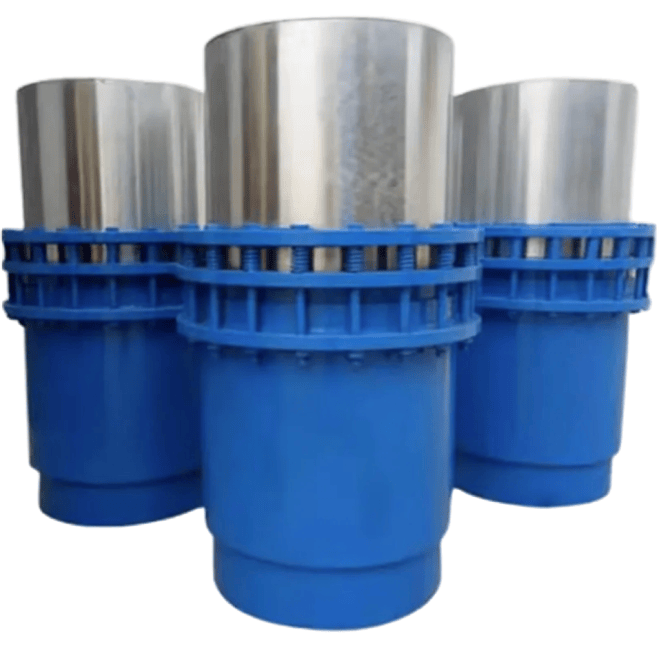
When selecting pipeline expansion components, many engineering purchasers and designers notice a common phenomenon: stock sleeve expansion joints on the market mostly adopt 200 mm as the basic axial compensation stroke, while the single-unit compensation capacity of conventional bellows expansion joints generally ranges from 50 mm to 120 mm. This difference is jointly determined by product principles, application scenarios and production economy.
Why Do Sleeve Expansion Joints Generally Start With a Compensation Capacity of 200 mm?

The counter-flange inner diameter is smaller than the expansion joint's flange bore to: fully compress the rubber sealing surface and prevent leaks, avoid sharp edges cutting the rubber during vibration, and act as a retaining ring to prevent pull-out accidents. This protects the rubber and ensures safety—always use matching flanges during installation.
Technical Explanation: Why Is the Inner Diameter of the Matching Counter-Flange Often Smaller Than That of the Rubber Expansion Joint's Own Flange?