
Rubber Material Selection for 54% Phosphoric Acid Expansion Joints
author: Liuna
2026-07-07
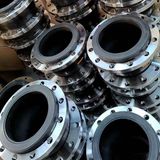
1. EPDM (Ethylene Propylene Diene Monomer) – First Choice for Normal Temperature
• Corrosion resistance: Excellent compatibility with 54% medium-concentration phosphoric acid at ambient temperature, minimal swelling, no cracking or pulverization under long-term service; resistant to phosphoric slurry and gypsum particle abrasion.
• Temperature range: Continuous service ≤80°C; short-term peak up to 90°C.
• Advantages: Cost-effective, outstanding vibration isolation, good anti-aging performance, widely stocked, compatible with ASME B16.5 piping projects.
• Limitation: Not resistant to mineral oil; swelling failure occurs if lubricant mixes into pipeline.
2. IIR / CIIR (Butyl Rubber / Chlorobutyl Rubber) – For Elevated Temperature (80–110°C)
• Corrosion resistance: Fully saturated molecular structure, superior acid resistance to standard EPDM; stable dimensional performance in hot phosphoric acid lines for wet-process phosphoric acid plants.
• Temperature range: IIR continuous ≤100°C; CIIR continuous up to 115°C.
• Drawbacks: Inferior elasticity and damping compared with EPDM, higher cost, poor low-temperature flexibility.
3. FKM (Fluoroelastomer / Viton) – Severe High-Temperature Service (>120°C)
• Corrosion resistance: Universal chemical resistance, stable long-term performance in 54% phosphoric acid up to 150°C, immune to concentrated acid and trace oxidizing impurities.
• Drawbacks: Very high material cost, stiff at low temperatures; rarely adopted for standard phosphoric acid pipelines.
Unsuitable Rubber Grades (Strictly Avoid for 54% Phosphoric Acid)
1. NR (Natural Rubber): Only usable short-term below 50°C; brittle and pulverized rapidly at elevated temperature.
2. CR (Neoprene): Poor acid resistance, severe swelling & delamination in 54% phosphoric acid.
3. NBR (Nitrile Butadiene Rubber): Not compatible with strong acid, fully excluded.
4. Silicone Rubber: Hydrolysis failure under long-term phosphoric acid immersion.
Matching Structural Recommendations for 54% Phosphoric Acid
1. Thickened acid-resistant inner rubber layer with steel wire reinforcement.
2. High-temperature working condition: EPDM lined with PTFE for double anti-corrosion protection.
3. Flange thickness complies with ASME B16.5 minimum standard; thickness reduction is prohibited. Short expansion joints must be equipped with limit tie rods and fixed supports to counteract axial thrust.
Why Stainless Steel Bellows Expansion Joints Are Lined with PTFE ?
Tolerance Requirements for Installation Length of Rubber Expansion Joints
Related Article

Internal‑pressure bellows: medium inside bellows, inner liner inside, tie‑rods needed for large displacement.
External‑pressure bellows: medium outside bellows, nested sleeve structure, good anti‑instability, tie‑rods normally not required.
External‑pressure bellows: medium outside bellows, nested sleeve structure, good anti‑instability, tie‑rods normally not required.
Internal‑pressure vs External‑pressure Metal Bellows Expansion Joints ?

NBR rubber expansion joints fail in high-temperature thermal oil systems because thermal oil runs above 300°C, while NBR can only handle ~90–140°C. This extreme heat causes rapid oil-swelling (softening and seal failure) and thermo-oxidative aging (hardening and cracking). The joint quickly fails, leading to thermal oil leaks and fire hazards. Use stainless steel or specially insulated expansion joints instead.
Why NBR Rubber Expansion Joints Cannot Be Used in High-Temperature Thermal Oil Systems
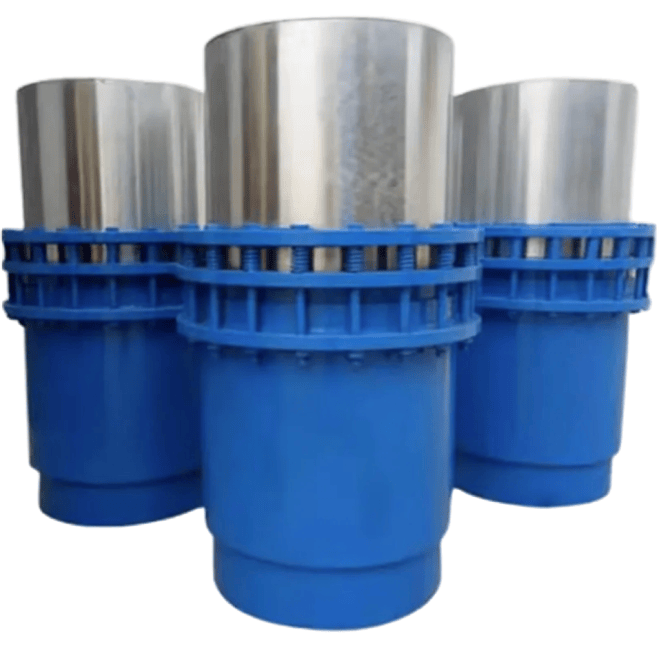
When selecting pipeline expansion components, many engineering purchasers and designers notice a common phenomenon: stock sleeve expansion joints on the market mostly adopt 200 mm as the basic axial compensation stroke, while the single-unit compensation capacity of conventional bellows expansion joints generally ranges from 50 mm to 120 mm. This difference is jointly determined by product principles, application scenarios and production economy.
Why Do Sleeve Expansion Joints Generally Start With a Compensation Capacity of 200 mm?

The counter-flange inner diameter is smaller than the expansion joint's flange bore to: fully compress the rubber sealing surface and prevent leaks, avoid sharp edges cutting the rubber during vibration, and act as a retaining ring to prevent pull-out accidents. This protects the rubber and ensures safety—always use matching flanges during installation.
Technical Explanation: Why Is the Inner Diameter of the Matching Counter-Flange Often Smaller Than That of the Rubber Expansion Joint's Own Flange?