
Why Stainless Steel Bellows Expansion Joints Are Lined with PTFE ?
author: Zhimin Yang
2023-07-08

Why Stainless Steel Bellows Expansion Joints Are Lined with PTFE
Stainless steel (304/316L/321) provides moderate corrosion resistance, yet a PTFE lining is required to fully isolate the metal substrate from process media for harsh working conditions.
The detailed reasons are as follows:


1. Stainless steel cannot resist strong corrosive fluids
Stainless steel relies on a thin chromium passivation film for anti-corrosion performance. This protective layer will be destroyed by aggressive media:
• Medium-concentration phosphoric acid, hydrochloric acid, hydrofluoric acid, chloride ions and sulfides cause pitting corrosion, intergranular corrosion and stress corrosion cracking.
• Bellows are thin-walled multi-layer structures with concentrated stress on welds and corrugation crevices, where corrosion penetrates and leaks preferentially.
• PTFE is chemically inert against nearly all acids and alkalis. The full lining separates corrosive media completely; stainless steel only bears pressure and displacement without contacting hazardous fluid.
2. Prevent scaling, crystallization and blockage of corrugations
The concave gaps of stainless steel bellows easily trap crystalline salts, phosphogypsum particles and precipitates:
• Accumulated sediments form concentration cells and accelerate metal corrosion; they also jam the bellows and eliminate its thermal compensation function.
• PTFE features an ultra-smooth, non-stick inner surface. Slurry and crystallizing media flow through without adhesion, maintaining long-term unobstructed pipeline circulation.
3. Avoid contamination of media by metal ions
Stainless steel slightly leaches iron, chromium and nickel under high-temperature acidic conditions:
• High-purity phosphoric acid, pharmaceutical and food pipelines forbid metal impurities mixing into products.
• PTFE releases no metallic contaminants and guarantees medium purity.
4. Double-layer leakage prevention for higher safety
Stainless steel bellows contain numerous thin weld seams; tiny corrosion holes will trigger fluid leakage.
The integrated PTFE liner acts as a complete isolation barrier. Even if minor corrosion damage occurs on the stainless steel bellows, media will not leak outward, eliminating environmental and safety risks for chemical pipelines.
The integrated PTFE liner acts as a complete isolation barrier. Even if minor corrosion damage occurs on the stainless steel bellows, media will not leak outward, eliminating environmental and safety risks for chemical pipelines.
5. Stable performance under wide temperature range
PTFE remains stable from -200°C to 200°C. Unlike rubber liners, it will not age or crack under frequent hot-cold cycling.
For high-temperature phosphoric acid service, the passivation film of stainless steel fails rapidly under heat; a PTFE liner drastically extends the service life of expansion joints.
For high-temperature phosphoric acid service, the passivation film of stainless steel fails rapidly under heat; a PTFE liner drastically extends the service life of expansion joints.
When PTFE lining is NOT required for stainless steel bellows
PTFE lining is unnecessary for neutral, non-corrosive media such as clean water, pure saturated steam and non-corrosive oil, to cut project costs.
Selection Note for 54% Phosphoric Acid Pipelines
316L stainless steel bellows can only be used for short-term service with 54% phosphoric acid, and will perforate within 1–2 years.
316L bellows with integral PTFE lining is the standard configuration for wet-process phosphoric acid pipelines to multiply service life.
For negative pressure working conditions, a PTFE supporting mesh must be installed inside the liner to avoid liner collapse and pipe blockage.
316L bellows with integral PTFE lining is the standard configuration for wet-process phosphoric acid pipelines to multiply service life.
For negative pressure working conditions, a PTFE supporting mesh must be installed inside the liner to avoid liner collapse and pipe blockage.
Mandatory Installation Conditions of Limit Tie Rods for Rubber Expansion Joints
Rubber Material Selection for 54% Phosphoric Acid Expansion Joints
Related Article

Internal‑pressure bellows: medium inside bellows, inner liner inside, tie‑rods needed for large displacement.
External‑pressure bellows: medium outside bellows, nested sleeve structure, good anti‑instability, tie‑rods normally not required.
External‑pressure bellows: medium outside bellows, nested sleeve structure, good anti‑instability, tie‑rods normally not required.
Internal‑pressure vs External‑pressure Metal Bellows Expansion Joints ?

NBR rubber expansion joints fail in high-temperature thermal oil systems because thermal oil runs above 300°C, while NBR can only handle ~90–140°C. This extreme heat causes rapid oil-swelling (softening and seal failure) and thermo-oxidative aging (hardening and cracking). The joint quickly fails, leading to thermal oil leaks and fire hazards. Use stainless steel or specially insulated expansion joints instead.
Why NBR Rubber Expansion Joints Cannot Be Used in High-Temperature Thermal Oil Systems
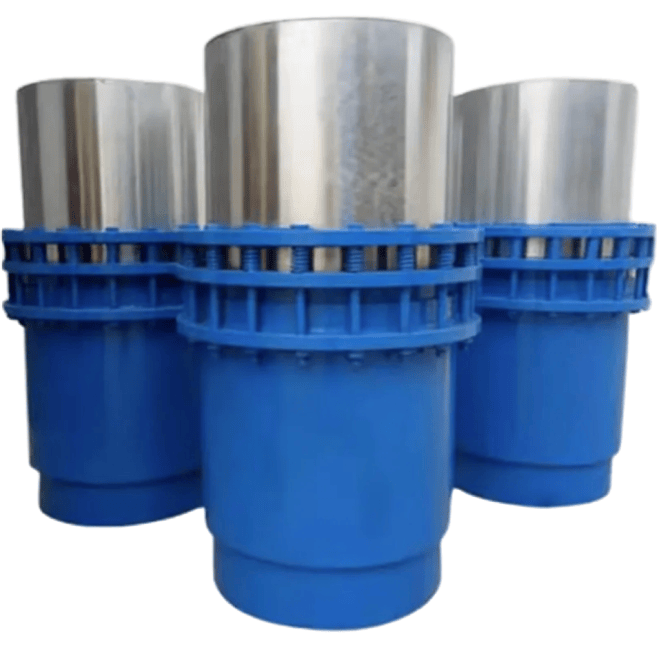
When selecting pipeline expansion components, many engineering purchasers and designers notice a common phenomenon: stock sleeve expansion joints on the market mostly adopt 200 mm as the basic axial compensation stroke, while the single-unit compensation capacity of conventional bellows expansion joints generally ranges from 50 mm to 120 mm. This difference is jointly determined by product principles, application scenarios and production economy.
Why Do Sleeve Expansion Joints Generally Start With a Compensation Capacity of 200 mm?

The counter-flange inner diameter is smaller than the expansion joint's flange bore to: fully compress the rubber sealing surface and prevent leaks, avoid sharp edges cutting the rubber during vibration, and act as a retaining ring to prevent pull-out accidents. This protects the rubber and ensures safety—always use matching flanges during installation.
Technical Explanation: Why Is the Inner Diameter of the Matching Counter-Flange Often Smaller Than That of the Rubber Expansion Joint's Own Flange?