
Why Metal Bellows Expansion Joints for Flue & Air Ducts Are Low Pressure Rated?
author: Zhimin Yang
2002-07-14

Why Metal Bellows Expansion Joints for Flue & Air Ducts Are Low Pressure Rated:
1. Inherent low-pressure working condition of flue gas systems
Boilers, dust removal and desulfurization duct systems rely on fans to convey flue gas. Operating pressure only ranges from hundreds to several thousand Pascals (0.001–0.03 MPa), far lower than chemical or steam pipelines. Many ducts work under negative pressure. The system itself does not require high-pressure expansion joints, so the standard design pressure is PN0.1 MPa (1 bar).
2. Rectangular large-size bellows have natural pressure limitations
Most flue ducts adopt oversized rectangular cross-sections:
• Stress concentrates severely at the four corners of rectangular bellows. Internal pressure easily causes bulging, buckling and distortion. Their maximum allowable pressure is limited to PN0.1 MPa.
• Thickening the bellows wall to boost pressure will stiffen the structure, eliminating flexibility to absorb large thermal displacement.
• Circular bellows can be reinforced with multiple layers or rings to bear high pressure, but such reinforcement works poorly for rectangular ducts and raises costs sharply.
3. High internal pressure creates huge thrust beyond support capacity
Axial thrust generated by internal pressure follows the formula: Thrust = Pressure × Cross-sectional Area.
Flue ducts have extra-large cross-sections. Even at 0.1 MPa, the thrust can reach over ten tons. Higher pressure will multiply this force, deforming steel supports and tearing welds. Low-pressure design reduces thrust and cuts construction costs for brackets and foundations.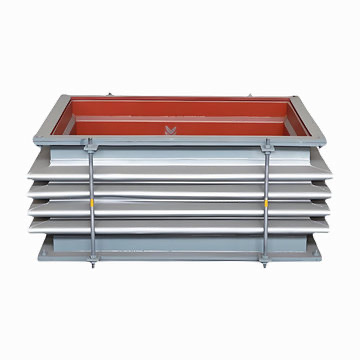
Flue ducts have extra-large cross-sections. Even at 0.1 MPa, the thrust can reach over ten tons. Higher pressure will multiply this force, deforming steel supports and tearing welds. Low-pressure design reduces thrust and cuts construction costs for brackets and foundations.
4. High temperature reduces metal strength
Flue gas runs at 200–600℃ for long periods. The yield strength of stainless steel drops significantly under high temperature. If designed for high pressure, bellows will creep and crack prematurely, shortening service life.
5. Low-pressure design balances compensation performance and cost
Flue ducts produce large thermal expansion displacement, requiring soft, multi-wave bellows for sufficient compensation. Thin-wall bellows for low pressure stretch flexibly. High-pressure bellows need thick walls, multi-layer structures and reinforcing rings, which greatly increase material and processing costs with no engineering value.
Supplementary Note
1. Small circular flue pipes (DN ≤ 600) can be customized for PN0.6 / PN1.0 pressure grades.
2. Most rectangular metal expansion joints for flue ducts have a maximum standard pressure of PN0.1 MPa.
3. For ducts below 0.05 MPa, non-metallic fabric expansion joints are widely used for lower cost and multi-directional compensation.
Brief Summary
Flue & air duct systems operate under micro-pressure. Combined with weak pressure resistance of large rectangular sections, excessive thrust under high pressure, degraded metal strength at high temperature and demand for flexible displacement absorption, metal bellows expansion joints for these ducts are all designed for low pressure.
Single vs Double Bellows Expansion Joints: Application Conditions
why flanged rubber expansion joints with integral rubber flanges require split (two-piece) backing flanges.
Related Article

Internal‑pressure bellows: medium inside bellows, inner liner inside, tie‑rods needed for large displacement.
External‑pressure bellows: medium outside bellows, nested sleeve structure, good anti‑instability, tie‑rods normally not required.
External‑pressure bellows: medium outside bellows, nested sleeve structure, good anti‑instability, tie‑rods normally not required.
Internal‑pressure vs External‑pressure Metal Bellows Expansion Joints ?

NBR rubber expansion joints fail in high-temperature thermal oil systems because thermal oil runs above 300°C, while NBR can only handle ~90–140°C. This extreme heat causes rapid oil-swelling (softening and seal failure) and thermo-oxidative aging (hardening and cracking). The joint quickly fails, leading to thermal oil leaks and fire hazards. Use stainless steel or specially insulated expansion joints instead.
Why NBR Rubber Expansion Joints Cannot Be Used in High-Temperature Thermal Oil Systems
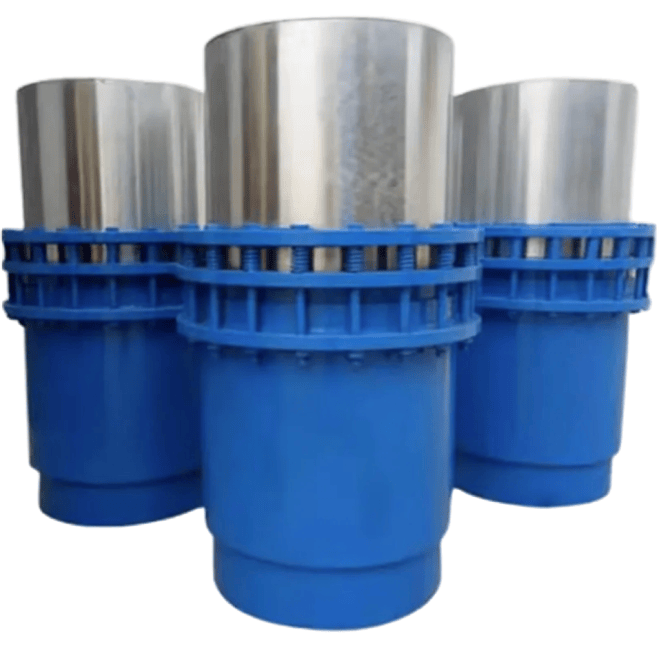
When selecting pipeline expansion components, many engineering purchasers and designers notice a common phenomenon: stock sleeve expansion joints on the market mostly adopt 200 mm as the basic axial compensation stroke, while the single-unit compensation capacity of conventional bellows expansion joints generally ranges from 50 mm to 120 mm. This difference is jointly determined by product principles, application scenarios and production economy.
Why Do Sleeve Expansion Joints Generally Start With a Compensation Capacity of 200 mm?

The counter-flange inner diameter is smaller than the expansion joint's flange bore to: fully compress the rubber sealing surface and prevent leaks, avoid sharp edges cutting the rubber during vibration, and act as a retaining ring to prevent pull-out accidents. This protects the rubber and ensures safety—always use matching flanges during installation.
Technical Explanation: Why Is the Inner Diameter of the Matching Counter-Flange Often Smaller Than That of the Rubber Expansion Joint's Own Flange?