
Single vs Double Bellows Expansion Joints: Application Conditions
author: Siyu Li
2026-07-16

Single vs Double Bellows Expansion Joints: Application Conditions
1. Single Bellows Expansion Joint (Single Unit)

Suitable working conditions
1. Straight pipelines with only axial thermal displacement
Straight flue ducts, heating water pipes, regular steam pipelines that only expand and contract lengthwise, without lateral deflection or angular rotation.
Straight flue ducts, heating water pipes, regular steam pipelines that only expand and contract lengthwise, without lateral deflection or angular rotation.
2. Limited installation space & small compensation requirement
Compact structure, low cost, for axial compensation within 150mm.
Compact structure, low cost, for axial compensation within 150mm.
3. Linear pipeline layout, no foundation settlement or equipment misalignment
Rigid fixed supports to bear full internal pressure thrust.
Rigid fixed supports to bear full internal pressure thrust.
4. Low & medium pressure service (PN0.1 ~ PN1.6)
Conventional water, normal-temperature flue gas, low-pressure steam without complex multi-directional deformation.
Conventional water, normal-temperature flue gas, low-pressure steam without complex multi-directional deformation.
Core feature
Only absorbs axial movement; cannot withstand large lateral offset; full pressure thrust transfers to pipeline fixed supports.
2. Double Bellows Expansion Joint (Twin Bellows with middle spool, tie rod / hinged type)

Suitable working conditions
1. Pipelines with lateral & multi-directional combined displacement
L-shaped / Z-shaped / U-shaped bent pipes, pipelines crossing settlement joints, uneven ground settlement sections.
Typical sites: boiler outlets, heat exchanger & pump connections, overhead pipe racks.
L-shaped / Z-shaped / U-shaped bent pipes, pipelines crossing settlement joints, uneven ground settlement sections.
Typical sites: boiler outlets, heat exchanger & pump connections, overhead pipe racks.
2. Need to absorb axial + lateral + angular deformation at the same time
Pulsating pipelines behind fans & compressors, large rectangular flue & gas ducts with complex thermal expansion.
Pulsating pipelines behind fans & compressors, large rectangular flue & gas ducts with complex thermal expansion.
3. Reduce load on pipeline supports (tie rod double type)
Built-in tie rods counteract huge pressure thrust from medium, eliminating heavy reinforced fixed supports to save construction cost, widely used for large-diameter flue ducts and high-pressure chemical pipelines.
Built-in tie rods counteract huge pressure thrust from medium, eliminating heavy reinforced fixed supports to save construction cost, widely used for large-diameter flue ducts and high-pressure chemical pipelines.
4. Large total compensation demand for long-distance pipelines
Total compensation capacity 1.5~2 times higher than single bellows, reduces the number of support sections for long heating networks.
Total compensation capacity 1.5~2 times higher than single bellows, reduces the number of support sections for long heating networks.
5. High-temperature, large-diameter & frequent fatigue cycling service
Two bellows share deformation stress for longer service life, for high-temperature hot air & blast furnace gas pipelines.
Two bellows share deformation stress for longer service life, for high-temperature hot air & blast furnace gas pipelines.
Quick Selection Rule
1. Straight pipeline, only axial expansion, no lateral offset → Single bellows expansion joint
2. Bent pipe, foundation settlement, equipment connection, lateral deflection, thrust reduction required → Double bellows expansion joint
Industry Note for Flue & Air Duct
1. Short straight flue with only lengthwise expansion: Single axial metal expansion joint
2. Large rectangular flue with multiple bends, foundation settlement, fan inlet/outlet: Double tie rod expansion joint
3. Multi-layer three-dimensional flue with all-direction displacement: Double universal hinged expansion joint
Technical Explanation: Why Is the Inner Diameter of the Matching Counter-Flange Often Smaller Than That of the Rubber Expansion Joint's Own Flange?
Why Metal Bellows Expansion Joints for Flue & Air Ducts Are Low Pressure Rated?
Related Article

Internal‑pressure bellows: medium inside bellows, inner liner inside, tie‑rods needed for large displacement.
External‑pressure bellows: medium outside bellows, nested sleeve structure, good anti‑instability, tie‑rods normally not required.
External‑pressure bellows: medium outside bellows, nested sleeve structure, good anti‑instability, tie‑rods normally not required.
Internal‑pressure vs External‑pressure Metal Bellows Expansion Joints ?

NBR rubber expansion joints fail in high-temperature thermal oil systems because thermal oil runs above 300°C, while NBR can only handle ~90–140°C. This extreme heat causes rapid oil-swelling (softening and seal failure) and thermo-oxidative aging (hardening and cracking). The joint quickly fails, leading to thermal oil leaks and fire hazards. Use stainless steel or specially insulated expansion joints instead.
Why NBR Rubber Expansion Joints Cannot Be Used in High-Temperature Thermal Oil Systems
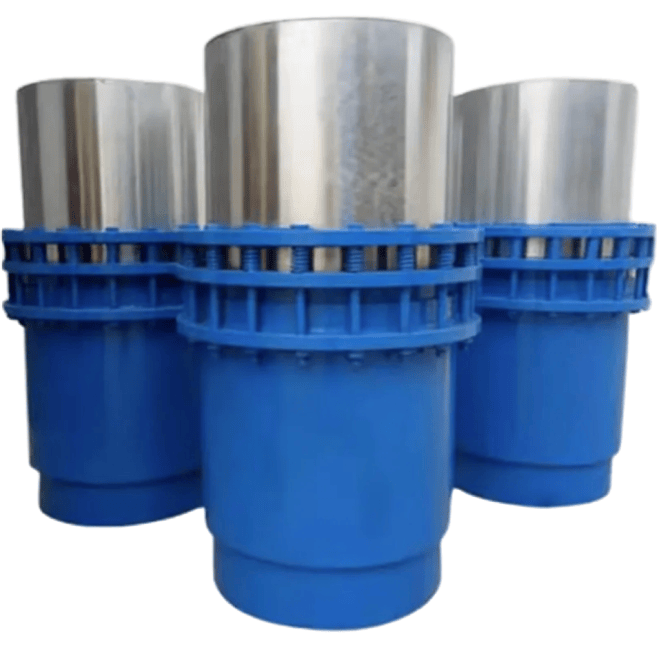
When selecting pipeline expansion components, many engineering purchasers and designers notice a common phenomenon: stock sleeve expansion joints on the market mostly adopt 200 mm as the basic axial compensation stroke, while the single-unit compensation capacity of conventional bellows expansion joints generally ranges from 50 mm to 120 mm. This difference is jointly determined by product principles, application scenarios and production economy.
Why Do Sleeve Expansion Joints Generally Start With a Compensation Capacity of 200 mm?

The counter-flange inner diameter is smaller than the expansion joint's flange bore to: fully compress the rubber sealing surface and prevent leaks, avoid sharp edges cutting the rubber during vibration, and act as a retaining ring to prevent pull-out accidents. This protects the rubber and ensures safety—always use matching flanges during installation.
Technical Explanation: Why Is the Inner Diameter of the Matching Counter-Flange Often Smaller Than That of the Rubber Expansion Joint's Own Flange?