
Standard No. CJ/T 487-2015 Fabricated Sleeve Compensators for Urban Heating Pipelines
author: Zhimin Yang
2025-06-17


Sleeve Compensator vs Metal Bellows Expansion Joint
 VS
VS
1. Structure & Working Principle
Sleeve Compensator
Consists of inner sleeve, outer shell, packing seal and gland. It absorbs thermal displacement through sliding between inner and outer sleeves, adopting mechanical sliding packing seal with graphite packing as sealing medium.
Metal Bellows Expansion Joint
Integrated thin-walled stainless steel corrugated structure. It absorbs displacement by elastic deformation of corrugations (compression, extension & deflection). No sliding friction parts, sealed by integral metal forming.
2. Displacement Compensation Capacity
• Sleeve Compensator: Large single-unit axial compensation capacity, 3~8 times that of bellows under the same nominal diameter. Ideal for long-distance high-temperature pipelines with large thermal expansion.
• Metal Bellows Expansion Joint: Small compensation per single section. Multiple corrugations or double/tied types are required for large displacement; compact overall length.
3. Sealing & Leakage Risk (Core Difference)
Sleeve Compensator
Sliding friction causes packing abrasion and aging under high temperature & medium erosion. Risk of medium leakage. Regular tightening of gland and packing replacement are mandatory.
Not suitable for flammable, explosive or toxic media, mainly applied to hot water & steam heating pipelines.
Not suitable for flammable, explosive or toxic media, mainly applied to hot water & steam heating pipelines.
Metal Bellows Expansion Joint
No sliding friction, fully welded airtight structure with nearly zero leakage risk. Permanent sealing after factory assembly, maintenance-free throughout service life.
Widely used for natural gas, crude oil, chemical and water pipelines with strict sealing requirements.
Widely used for natural gas, crude oil, chemical and water pipelines with strict sealing requirements.
4. Applicable Pressure, Temperature & Medium
Sleeve Compensator
Suitable for medium & low pressure high-temperature steam/hot water heating network. Sealing performance declines sharply under high pressure.
Not recommended for corrosive media or buried pipelines (leakage inspection underground is difficult).
Not recommended for corrosive media or buried pipelines (leakage inspection underground is difficult).
Metal Bellows Expansion Joint
Optional materials: 304 / 316L / Hastelloy, excellent acid & alkali resistance. Operating temperature range: -196℃ ~ 600℃, compatible with low to high pressure.
Applicable to buried, overhead, chemical, gas and oil transmission pipelines.
Applicable to buried, overhead, chemical, gas and oil transmission pipelines.
5. Installation, Space & Maintenance
Sleeve Compensator
Long overall length, occupies large space in pipe gallery. Large sliding friction force, additional guide supports are required.
Regular maintenance is compulsory: Seal inspection, gland retightening and periodic packing replacement.
Regular maintenance is compulsory: Seal inspection, gland retightening and periodic packing replacement.
Metal Bellows Expansion Joint
Compact size with small installation footprint. Low elastic resistance, simple guide supports suffice.
Zero maintenance after installation, great advantage for underground buried pipelines.
Zero maintenance after installation, great advantage for underground buried pipelines.
6. Service Life
• Sleeve Compensator: Wearing packing limits lifespan. Seal replacement required every 3~5 years, total service life approx. 10 years.
• Metal Bellows Expansion Joint: No wearing components. Normal service life 15~30 years, matching pipeline service cycle.
7. Stability & Displacement Absorption
• Sleeve Compensator: High rigidity, no instability risk; only absorbs axial displacement, cannot accommodate lateral or angular offset.
• Metal Bellows Expansion Joint: Absorbs axial, lateral and angular displacement simultaneously. Risk of corrugation buckling under high pressure or long length; tie rods needed for protection.
8. Application Summary
Sleeve Compensator
Urban central heating overhead pipelines transporting high-temperature steam/hot water. Scenarios requiring large axial compensation, non-flammable medium and easy ground maintenance access.
Metal Bellows Expansion Joint
1. Pipelines carrying flammable, explosive or toxic gas/oil/chemical media
2. Buried pipelines & underground pipe galleries with inconvenient maintenance
3. Complex piping systems with lateral & angular misalignment
4. Corrosive or cryogenic special process pipelines
Comparison Table
Comparison Item Sleeve Compensator Metal Bellows Expansion Joint
Compensation Principle Telescopic sliding of inner & outer sleeves Elastic deformation of metal corrugations
Single-unit Compensation Volume Large Small
Sealing Structure Sliding packing seal, prone to leakage Integral metal seal, near zero leakage
Maintenance Requirement Periodic packing replacement & gland tightening Maintenance-free
Absorbable Displacement Only axial displacement Axial, lateral & angular 3-way displacement
Applicable Media Hot water, heating steam Gas, oil, chemical, heating, water supply & drainage
Buried Installation Not recommended Highly recommended
Service Life Relatively short Long
Leakage Risk High Extremely low
Comparison Item Sleeve Compensator Metal Bellows Expansion Joint
Compensation Principle Telescopic sliding of inner & outer sleeves Elastic deformation of metal corrugations
Single-unit Compensation Volume Large Small
Sealing Structure Sliding packing seal, prone to leakage Integral metal seal, near zero leakage
Maintenance Requirement Periodic packing replacement & gland tightening Maintenance-free
Absorbable Displacement Only axial displacement Axial, lateral & angular 3-way displacement
Applicable Media Hot water, heating steam Gas, oil, chemical, heating, water supply & drainage
Buried Installation Not recommended Highly recommended
Service Life Relatively short Long
Leakage Risk High Extremely low
Why Most Sleeve Expansion Joints Adopt Welded Connection
Comparison of Fatigue Life: Single Layer 1.2mm vs Double Layer 0.6mm DN300 Bellows (Without Inner Liner)
Related Article

Internal‑pressure bellows: medium inside bellows, inner liner inside, tie‑rods needed for large displacement.
External‑pressure bellows: medium outside bellows, nested sleeve structure, good anti‑instability, tie‑rods normally not required.
External‑pressure bellows: medium outside bellows, nested sleeve structure, good anti‑instability, tie‑rods normally not required.
Internal‑pressure vs External‑pressure Metal Bellows Expansion Joints ?

NBR rubber expansion joints fail in high-temperature thermal oil systems because thermal oil runs above 300°C, while NBR can only handle ~90–140°C. This extreme heat causes rapid oil-swelling (softening and seal failure) and thermo-oxidative aging (hardening and cracking). The joint quickly fails, leading to thermal oil leaks and fire hazards. Use stainless steel or specially insulated expansion joints instead.
Why NBR Rubber Expansion Joints Cannot Be Used in High-Temperature Thermal Oil Systems
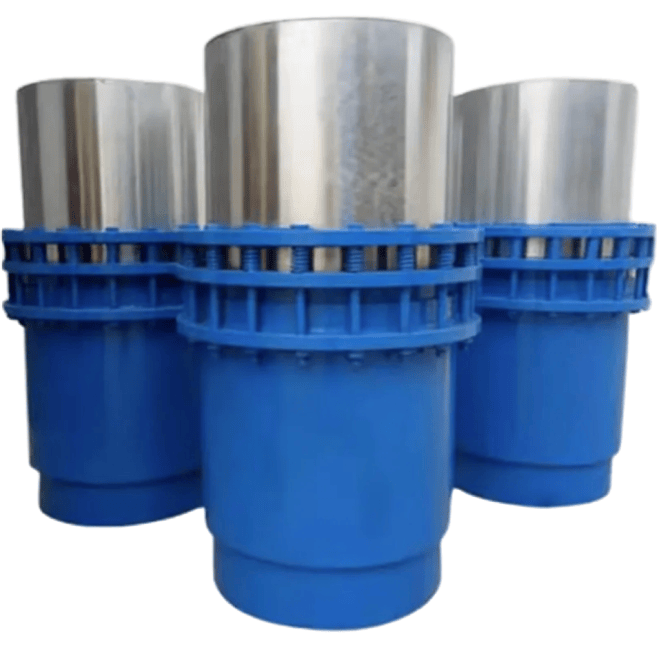
When selecting pipeline expansion components, many engineering purchasers and designers notice a common phenomenon: stock sleeve expansion joints on the market mostly adopt 200 mm as the basic axial compensation stroke, while the single-unit compensation capacity of conventional bellows expansion joints generally ranges from 50 mm to 120 mm. This difference is jointly determined by product principles, application scenarios and production economy.
Why Do Sleeve Expansion Joints Generally Start With a Compensation Capacity of 200 mm?

The counter-flange inner diameter is smaller than the expansion joint's flange bore to: fully compress the rubber sealing surface and prevent leaks, avoid sharp edges cutting the rubber during vibration, and act as a retaining ring to prevent pull-out accidents. This protects the rubber and ensures safety—always use matching flanges during installation.
Technical Explanation: Why Is the Inner Diameter of the Matching Counter-Flange Often Smaller Than That of the Rubber Expansion Joint's Own Flange?