
Tolerance Requirements for Installation Length of Rubber Expansion Joints
author: Siyu Li
2026-07-02
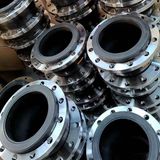
1. General On-site Installation Tolerance
- The standard dimensional tolerance for the distance between two flange sealing faces is ±5 mm under actual pipeline installation conditions.
- The suggested installation method is to slightly pre-compress the product by 3~5 mm during assembly, making the overall installation length tolerance range controlled between -5 mm and 0 mm. It is strictly prohibited to stretch the rubber expansion joint beyond its rated axial elongation limit to match pipe dimensions.
- Relevant specification basis GB50184 clearly stipulates that the allowable deviation of reserved expansion and contraction clearance of pipeline compensators is 5 mm. Excessive positive or negative dimensional deviation will greatly shorten the service life of the rubber joint, and easily lead to rubber cracking, internal delamination and medium leakage under continuous operating pressure.
2. Factory Free State Length Tolerance (Executed in accordance with HG/T2289 Standard)
The free length refers to the natural length of the rubber expansion joint without any external tension or compression before delivery, with graded tolerance standards divided by nominal diameter:
- Nominal diameter DN50 and below small-size joints: tolerance ±3 mm
- Nominal diameter DN65 ~ DN300 medium-size joints: tolerance ±5 mm
- Large diameter specifications DN350 and above: tolerance ±8 mm
3. Critical Usage Restrictions
Rubber expansion joints are designed for absorbing thermal displacement and minor installation offsets, and it is not allowed to rely on forced stretching or compressing rubber expansion joints to offset large pipe length errors.
- Conventional single-ball rubber expansion joint: rated axial elongation capacity 10~20 mm, rated axial compression capacity 10 mm. These deformation values are the safe service range, not the allowable installation adjustment margin.
- If the installation length deviation exceeds ±5 mm, the rubber body will bear abnormal long-term tensile or compressive stress, resulting in rubber cracking, fabric layer delamination and medium leakage after long-term service.
4. General Acceptance Standard for Water Supply, Drainage and Chemical Pipelines
For conventional water supply, drainage and general chemical medium pipelines, the unified acceptance rule is as follows: the overall tolerance of finished installation length is ±5 mm. The optimal installation state is slight compression (length deviation 0 ~ -5 mm), which can help the joint buffer pipeline thermal elongation in advance. Forced stretching installation that pulls the joint longer than its nominal length is strictly prohibited.
Rubber Material Selection for 54% Phosphoric Acid Expansion Joints
Operating Conditions for Using Sleeve Compensators Instead of Bellows Expansion Joints
Related Article

Internal‑pressure bellows: medium inside bellows, inner liner inside, tie‑rods needed for large displacement.
External‑pressure bellows: medium outside bellows, nested sleeve structure, good anti‑instability, tie‑rods normally not required.
External‑pressure bellows: medium outside bellows, nested sleeve structure, good anti‑instability, tie‑rods normally not required.
Internal‑pressure vs External‑pressure Metal Bellows Expansion Joints ?

NBR rubber expansion joints fail in high-temperature thermal oil systems because thermal oil runs above 300°C, while NBR can only handle ~90–140°C. This extreme heat causes rapid oil-swelling (softening and seal failure) and thermo-oxidative aging (hardening and cracking). The joint quickly fails, leading to thermal oil leaks and fire hazards. Use stainless steel or specially insulated expansion joints instead.
Why NBR Rubber Expansion Joints Cannot Be Used in High-Temperature Thermal Oil Systems
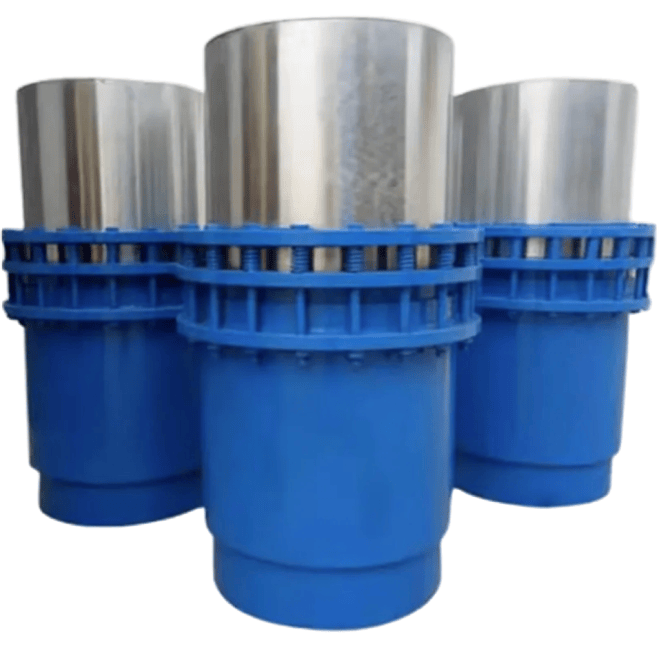
When selecting pipeline expansion components, many engineering purchasers and designers notice a common phenomenon: stock sleeve expansion joints on the market mostly adopt 200 mm as the basic axial compensation stroke, while the single-unit compensation capacity of conventional bellows expansion joints generally ranges from 50 mm to 120 mm. This difference is jointly determined by product principles, application scenarios and production economy.
Why Do Sleeve Expansion Joints Generally Start With a Compensation Capacity of 200 mm?

The counter-flange inner diameter is smaller than the expansion joint's flange bore to: fully compress the rubber sealing surface and prevent leaks, avoid sharp edges cutting the rubber during vibration, and act as a retaining ring to prevent pull-out accidents. This protects the rubber and ensures safety—always use matching flanges during installation.
Technical Explanation: Why Is the Inner Diameter of the Matching Counter-Flange Often Smaller Than That of the Rubber Expansion Joint's Own Flange?