
Why Most Sleeve Expansion Joints Adopt Welded Connection
author: LIUNA
2025-05-13

Welded connection is the mainstream installation method for sleeve expansion joints, especially for high-temperature, high-pressure steam heating pipelines and buried long-distance piping systems. Flange connection is only used for low-pressure pipelines requiring frequent disassembly. The core reasons are summarized as follows:
1. Superior Pressure and Temperature Resistance
Sleeve compensators are commonly applied in working conditions of 0.6–4.0 MPa pressure and up to 600 °C high temperature.
Flange connections rely on gaskets for sealing. Under long-term high temperature, gaskets will age, creep and lose elasticity; under high pressure, flange bolts tend to stretch and loosen, easily causing medium leakage.
In contrast, welded joints form an integrated metal fusion structure without vulnerable gasket components. They maintain stable sealing performance under extreme temperature and pressure for a long time, achieving the same service life as the pipeline.
Flange connections rely on gaskets for sealing. Under long-term high temperature, gaskets will age, creep and lose elasticity; under high pressure, flange bolts tend to stretch and loosen, easily causing medium leakage.
In contrast, welded joints form an integrated metal fusion structure without vulnerable gasket components. They maintain stable sealing performance under extreme temperature and pressure for a long time, achieving the same service life as the pipeline.
2. Higher Structural Rigidity to Resist Axial Thrust
Thermal expansion of pipelines generates huge axial thrust during operation.
Flange connections bear force only through bolts. Under large axial load, flange faces are prone to deformation and opening gaps, which damages the sealing effect.
Welded ends integrate the sleeve compensator with the whole pipeline. The weld seam uniformly bears axial stress with high overall rigidity. It effectively avoids core tube eccentricity and friction abrasion, ensuring smooth telescopic movement of the sleeve structure.
Flange connections bear force only through bolts. Under large axial load, flange faces are prone to deformation and opening gaps, which damages the sealing effect.
Welded ends integrate the sleeve compensator with the whole pipeline. The weld seam uniformly bears axial stress with high overall rigidity. It effectively avoids core tube eccentricity and friction abrasion, ensuring smooth telescopic movement of the sleeve structure.
3. Perfect Adaptability for Buried Pipeline Engineering
Most municipal heating sleeve compensators are installed underground.
Buried pipelines face long-term soil pressure, foundation settlement and groundwater corrosion. Flange gaskets usually fail within 3–5 years, leading to frequent leakage and high maintenance excavation costs.
Welded joints can be fully protected by anti-corrosion and insulation treatment after welding, with no exposed wearing parts. They realize maintenance-free service for decades and meet the pre-expansion fixation requirements of direct-buried pipeline standards.
Buried pipelines face long-term soil pressure, foundation settlement and groundwater corrosion. Flange gaskets usually fail within 3–5 years, leading to frequent leakage and high maintenance excavation costs.
Welded joints can be fully protected by anti-corrosion and insulation treatment after welding, with no exposed wearing parts. They realize maintenance-free service for decades and meet the pre-expansion fixation requirements of direct-buried pipeline standards.
4. Lower Comprehensive Cost and Simplified Structure
Welded-type sleeve joints omit flanges, high-strength bolts and special sealing gaskets, greatly reducing manufacturing and material costs, especially for large-diameter pipelines.
Welded construction is more efficient for long-distance pipeline projects. Meanwhile, the internal packing sealing structure of the sleeve compensator is completely independent of the end connection mode. Welded installation does not affect later packing replacement and routine maintenance.
Welded construction is more efficient for long-distance pipeline projects. Meanwhile, the internal packing sealing structure of the sleeve compensator is completely independent of the end connection mode. Welded installation does not affect later packing replacement and routine maintenance.
5. Higher Operational Safety
The medium of thermal pipelines is mostly high-temperature hot water or steam. Flange connections have multiple leakage risks including gaskets, bolt holes and sealing surfaces, which may cause scalding accidents and pipeline damage.
Qualified welded seams form an integral metal seal with only one connecting interface, which greatly reduces leakage risks and improves the overall safety and stability of the piping system.
Qualified welded seams form an integral metal seal with only one connecting interface, which greatly reduces leakage risks and improves the overall safety and stability of the piping system.
Difference Between Full face Rubber Expansion Joint and Grooved Rubber Expansion Joint (Performance & Application)
Standard No. CJ/T 487-2015 Fabricated Sleeve Compensators for Urban Heating Pipelines
Related Article

Internal‑pressure bellows: medium inside bellows, inner liner inside, tie‑rods needed for large displacement.
External‑pressure bellows: medium outside bellows, nested sleeve structure, good anti‑instability, tie‑rods normally not required.
External‑pressure bellows: medium outside bellows, nested sleeve structure, good anti‑instability, tie‑rods normally not required.
Internal‑pressure vs External‑pressure Metal Bellows Expansion Joints ?

NBR rubber expansion joints fail in high-temperature thermal oil systems because thermal oil runs above 300°C, while NBR can only handle ~90–140°C. This extreme heat causes rapid oil-swelling (softening and seal failure) and thermo-oxidative aging (hardening and cracking). The joint quickly fails, leading to thermal oil leaks and fire hazards. Use stainless steel or specially insulated expansion joints instead.
Why NBR Rubber Expansion Joints Cannot Be Used in High-Temperature Thermal Oil Systems
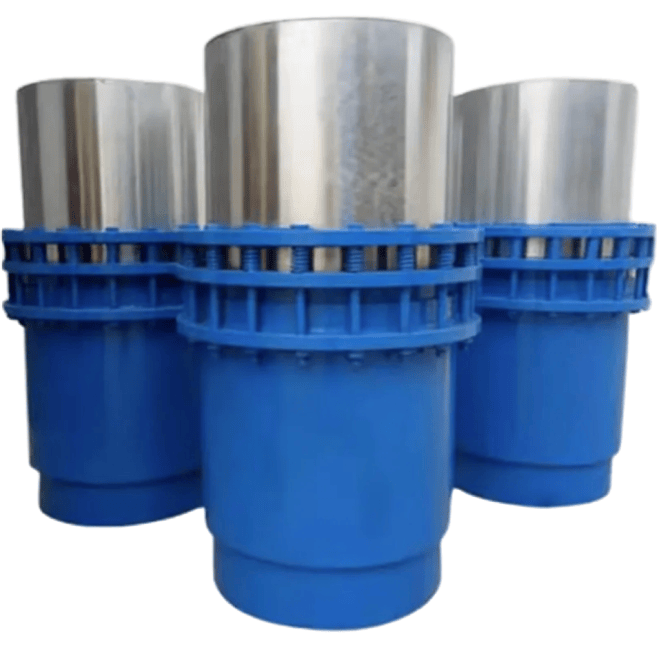
When selecting pipeline expansion components, many engineering purchasers and designers notice a common phenomenon: stock sleeve expansion joints on the market mostly adopt 200 mm as the basic axial compensation stroke, while the single-unit compensation capacity of conventional bellows expansion joints generally ranges from 50 mm to 120 mm. This difference is jointly determined by product principles, application scenarios and production economy.
Why Do Sleeve Expansion Joints Generally Start With a Compensation Capacity of 200 mm?

The counter-flange inner diameter is smaller than the expansion joint's flange bore to: fully compress the rubber sealing surface and prevent leaks, avoid sharp edges cutting the rubber during vibration, and act as a retaining ring to prevent pull-out accidents. This protects the rubber and ensures safety—always use matching flanges during installation.
Technical Explanation: Why Is the Inner Diameter of the Matching Counter-Flange Often Smaller Than That of the Rubber Expansion Joint's Own Flange?